




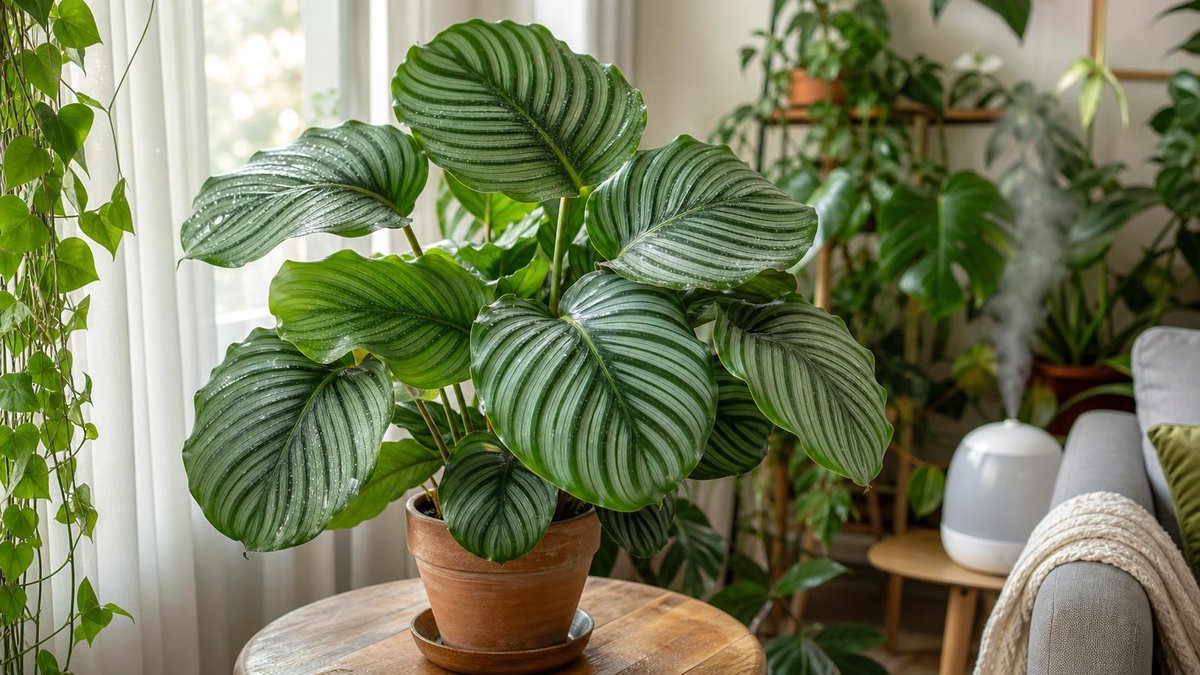
Calathea leaves earn their keep. Painted, patterned, and mobile; they shift from day to night like clockwork. Yet the “difficult” reputation sticks, and for good reason. These are Brazilian forest-floor plants. Small deviations in conditions produce dramatic results: curled leaves, crispy edges, collapse. Getting calathea care right means replicating what they evolved for, with numbers you can measure.
The genus Calathea (now partially reclassified as Goeppertia) holds roughly 300 species. A dozen circulate widely in cultivation. Calathea ornata carries pink pinstripes. C. lancifolia (rattlesnake plant) has elongated spotted leaves. C. orbifolia shows silver-green bands. C. makoyana (peacock plant) bears eye-like markings. C. roseopicta ‘Dottie’ goes dark-leaved. Same fundamentals across the board. Some tolerate marginally drier air; none tolerate much.
Quick care summary
| Factor | Optimal range | Source |
|---|---|---|
| Light | Bright indirect; 400-800 foot-candles | RHS, Calathea cultivation guidance |
| Temperature | 18-24°C (65-75°F), minimum 15°C (59°F) | Kew, tropical houseplant database |
| Humidity | 60% relative humidity minimum; 70-80% preferred | RHS, Calathea care notes |
| Watering | When top 2.5-5cm (1-2in) of soil dries; use filtered or rainwater | Kew, water quality guidelines |
| Soil pH | 6.0-6.5, slightly acidic | University of Florida IFAS Extension |
| Feeding | Balanced liquid at half strength, every 2-4 weeks in growing season | RHS, houseplant feeding guidance |
Light requirements
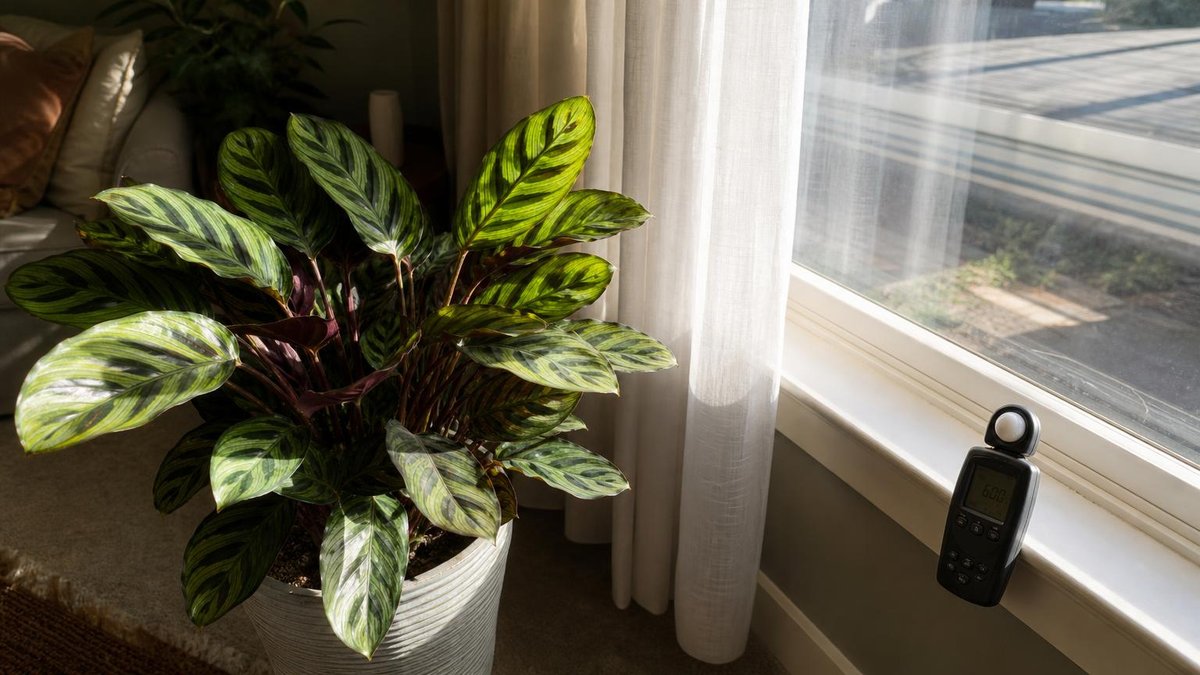
Calathea grow on shaded tropical forest floors beneath dense canopy. Direct sun burns leaves within hours. Those bleached patches won’t recover. Too little light, and you’ll get leggy growth with washed-out patterns. Shoot for 400-800 foot-candles of indirect light. In practice, that’s 1-2 meters back from an east-facing window, or 2-3 meters from south or west exposures with sheer filtering.
Your plant will tell you what’s wrong. In Calathea ornata, pink stripes fade to cream when light drops. Petioles stretch toward windows. That nightly folding (nyctinastic movement) weakens or stops. New leaves emerging slower than every 6-8 weeks? That’s your cue. Rotate the pot 90 degrees weekly for even growth. No decent natural light? Hang a full-spectrum LED 30-45cm above the canopy and run it 12-14 hours daily.
Watering and water quality
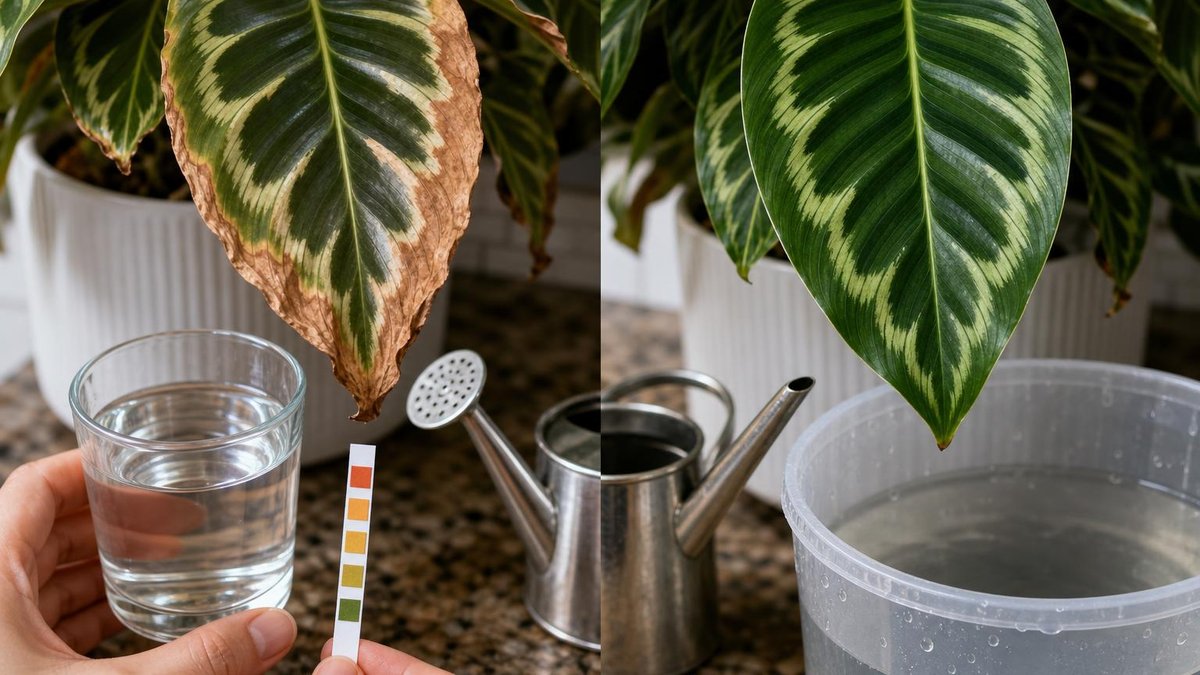
Here’s where most calathea plant care falls apart. These plants hate both drought and dissolved minerals. Hard tap water loads soil with fluoride, chlorine, and calcium carbonate. Brown, papery leaf margins follow. That tip burn is permanent.
Water when the top 2.5-5cm of potting mix feels dry to your first knuckle. Not on a calendar. In a 15cm pot under typical indoor conditions, expect every 5-7 days in summer and 7-10 days in winter, though heating systems and humidity shift this considerably. A soil moisture meter cuts out the guesswork; water when it reads 3-4 on the dry end of a 1-10 scale.
Rainwater, distilled, or filtered water left to stand 24 hours. Room temperature. If your tap water exceeds 300 ppm total dissolved solids, skip it entirely. Never let calathea sit in standing water; root rot from anaerobic conditions sets in within 48-72 hours of saturated soil. Pots need drainage holes. Dump excess from saucers within 30 minutes.
Humidity and temperature
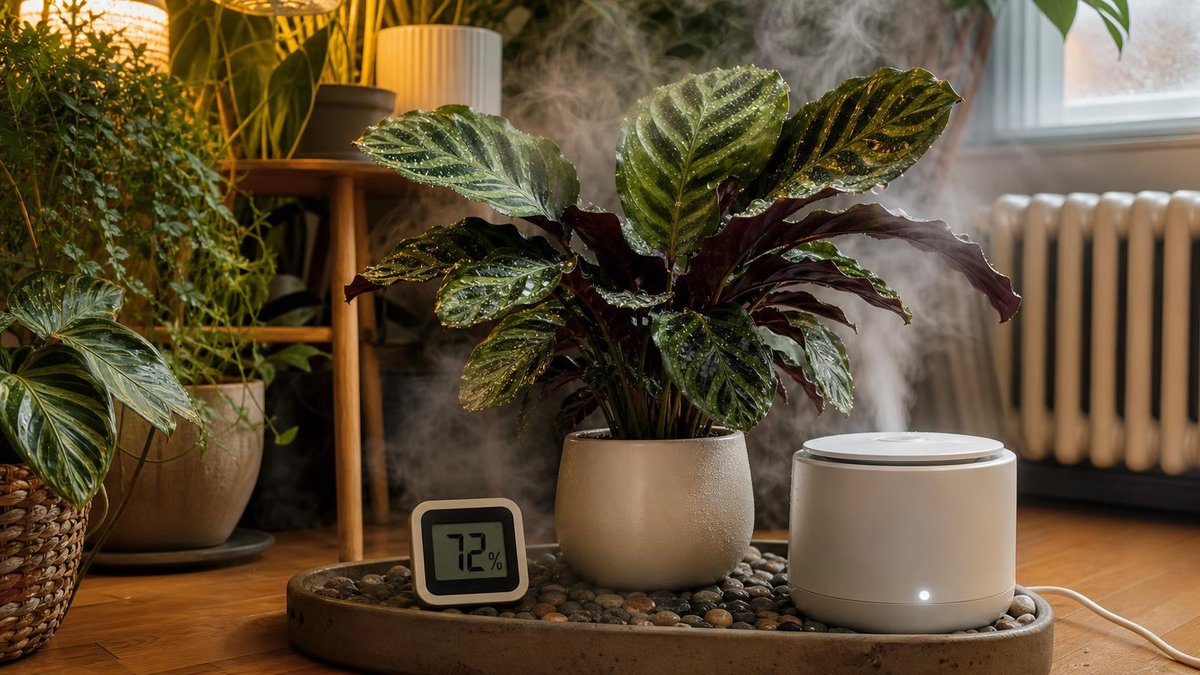
Calathea humidity requirements aren’t negotiable. Below 50% RH, edges desiccate regardless of how precisely you water. Below 40%, decline speeds up. Winter heating routinely drops homes to 20-30%. That kills them, slowly.
What actually works, ranked:
- Humidifier: 60-70% RH at plant level. Ultrasonic, 4-6 liter tank, 12-24 hours between refills.
- Grouped plants: Transpiration bumps local humidity 10-15% inside 30cm.
- Pebble tray: 5-10% lift right above the water. Useless beyond 15cm from the pot.
- Misting: 15-30 minutes of relief. Fine for rescue, not maintenance.
Temperature stability matters as much as the reading itself. Cold drafts from windows, doors, or air conditioning vents cause chilling injury below 15°C. Swings of more than 5°C in 24 hours trigger leaf curling as a protective response. Keep calathea away from radiators and heat sources that create dry thermal columns.
Soil and potting
Calathea need a mix that holds moisture yet stays aerated. Standard peat-based compost sits too wet; pure coco coir dries unevenly. Here’s a blend that actually works:
- 40% peat-free houseplant compost or high-quality coir
- 30% perlite or pumice (2-5mm grade) for aeration
- 20% orchid bark (small grade, 5-10mm) for structural drainage
- 10% worm castings or well-composted organic matter for nutrient content
That mix holds moisture 5-7 days in a 15cm pot without drowning roots. pH: 6.0-6.5. Repot in spring, every 12-18 months, or when roots circle the base or poke through drainage holes. Move up one size only (2.5-5cm wider). Extra soil without roots to fill it stays wet. Promotes rot. After repotting, keep humidity high for 2-3 weeks while roots anchor.
Feeding schedule
Calathea are moderate feeders with sensitive roots prone to fertilizer burn. Feed March through September: balanced liquid, half strength, every 2-4 weeks. A 10-10-10 or 20-20-20 at 0.5-1.0 ml per liter supplies nitrogen for foliage without salt buildup.
Drop to monthly in autumn. Stop entirely in winter; low light and temperature mean the plant isn’t using it. Flush the pot with plain water every 8-12 weeks to leach salts, especially on tap water. Overfeeding shows as brown margins with yellow halos, or white crust on the soil surface.
Common problems and fixes
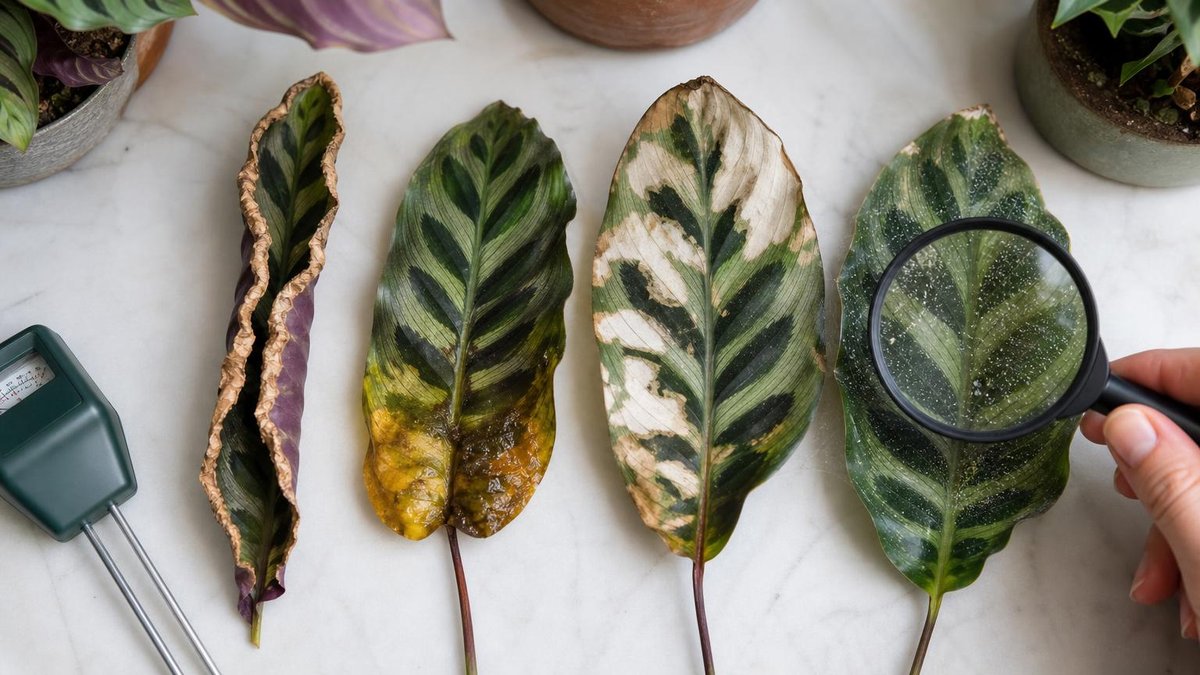
Calathea communicate distress visibly and rapidly. The calathea leaf curling fix depends on identifying the correct cause, since multiple stressors produce similar symptoms.
| Symptom | Most likely cause | Measurable fix |
|---|---|---|
| Leaf curling, upright | Underwatering or low humidity | Check soil moisture at 5cm depth; increase humidity to 60%+ |
| Brown, crispy leaf margins | Fluoride/chlorine toxicity or low humidity | Switch to rainwater; maintain 65%+ RH |
| Yellowing lower leaves | Natural senescence or overwatering | Check roots for rot; reduce watering frequency if soil stays wet >5 days |
| Pale, washed-out foliage | Excess direct light or nitrogen deficiency | Move to lower light; verify feeding schedule |
| No nyctinastic movement | Insufficient light or temperature stress | Measure light levels; check for drafts or heat sources |
Pests show up less often than cultural problems but need fast action. Spider mites love dry air. Look for fine webbing, stippled yellow dots. Raise humidity first. Then insecticidal soap or horticultural oil, weekly, three rounds. Mealybugs colonize leaf axils; dab with 70% isopropyl alcohol on cotton swabs, then apply systemic insecticide for heavy infestations.
Calathea propagation methods
Calathea propagation is limited to division. These plants won’t root from leaf or stem cuttings. Divide in spring when new growth begins, timing it with repotting:
- Remove the plant from its pot and gently tease away loose soil to expose the root ball
- Identify natural divisions where multiple stems emerge from separate rhizome sections with independent root systems
- Separate by hand where possible; use a clean, sharp knife only for dense, interwoven roots
- Ensure each division has at least 3-4 healthy leaves and substantial roots
- Pot in fresh mix at the same depth as previously grown
- Maintain high humidity (70%+) and consistent moisture for 4-6 weeks until establishment
Success rate exceeds 80% for divisions with adequate root mass. Don’t try this in autumn or winter; low light and temperature prevent root regeneration.
Toxicity and pet safety
Disclaimer: The following information addresses commonly reported effects. Individual reactions vary. For any suspected ingestion, contact a professional immediately.
Calathea are non-toxic to cats and dogs according to ASPCA classification. The organization lists both Calathea and Goeppertia species as non-toxic to cats, dogs, and horses. However, non-toxic does not mean edible. Ingestion may cause mild gastrointestinal upset (drooling, vomiting, or reduced appetite) due to mechanical irritation from plant fibers. The ASPCA Animal Poison Control Center operates 24 hours at 888-426-4435; a consultation fee may apply. Human sensitivity varies; the sap may cause minor skin irritation in sensitive individuals.
Variety-specific notes
While fundamental requirements align, certain varieties present distinct characteristics:
- Calathea ornata care: Pink pinstripes fade permanently in insufficient light; requires brightest indirect conditions of the genus. Most sensitive to water quality.
- Calathea lancifolia care (rattlesnake calathea): Most tolerant of moderate humidity, surviving at 50% RH with minimal tip burn. Elongated leaves show underwatering faster than broad-leaved species.
- Calathea orbifolia care: Largest leaves and slowest growth. Most susceptible to spider mites due to broad leaf surfaces. Needs stable conditions; avoid any drafts.
- Calathea makoyana care: Compact habit suits smaller spaces. Peacock patterning is most light-responsive; dramatic fading occurs within 2 weeks of suboptimal placement.
- Calathea dottie care: Dark purple-black foliage with pink venation. Slightly more light-demanding than green varieties to maintain color intensity.
- Calathea roseopicta care: Multiple cultivars including ‘Dottie’, ‘Medallion’, and ‘Corona’. Generally robust within the genus; good starting point for beginners.
Creating your care routine
Consistent calathea care rewards you with sustained growth and intact foliage. Check yours twice weekly: once for soil moisture, again for humidity and pests. This routine catches problems before they become visible damage.
For apartment dwellers, calathea present specific challenges. First apartment plant growers should consider starting with Calathea lancifolia or C. roseopicta before attempting C. ornata or C. orbifolia. The learning curve is real, but the skills transfer directly to other demanding tropicals like maranta and stromanthe. If you cannot maintain humidity above 50%, reconsider calathea as a choice; no amount of technique overcomes fundamentally incompatible conditions.
Frequently asked questions
Watering and environment
How often should I water my calathea?
Water when the top 2.5-5cm of soil dries, typically every 5-7 days in summer and 7-10 days in winter for a 15cm pot. Use your finger or a moisture meter rather than a calendar. Frequency shifts with humidity, temperature, pot size, and soil composition.
Why are my calathea leaves curling?
Leaf curling usually signals water stress: either underwatering or low humidity below 50% RH. Check soil moisture at 5cm depth first. If soil’s adequately moist, push humidity to 60%+ with a humidifier. Curled leaves that stay turgid point to temperature stress or root damage from overwatering.
Can I use tap water for my calathea?
Only if your water is soft (below 100 ppm total dissolved solids). Most municipal water exceeds this, containing minerals that accumulate and cause brown leaf margins. Rainwater, distilled water, or reverse osmosis filtered water prevents this damage. If tap water is your only option, let it stand 24 hours to dissipate chlorine, though this won’t remove fluoride or dissolved minerals.
Growth and maintenance
How do I propagate calathea?
Calathea propagation is by division only, ideally in spring. Separate the root ball into sections with at least 3-4 leaves and independent root systems. Pot in fresh, moist mix and maintain high humidity for 4-6 weeks. Leaf or stem cuttings won’t root. Single-stem divisions have low survival rates; ensure substantial roots on each piece.
Why has my calathea stopped moving its leaves at night?
Nyctinastic movement needs adequate light energy to fuel the pulvini (specialized cells at leaf bases). Dim conditions below 200 foot-candles, temperature below 15°C, or root stress from overwatering all shut this down. Measure your light levels and verify soil moisture to find the culprit.
Should I mist my calathea?
Misting gives a temporary humidity bump for 15-30 minutes and can help acute stress, but it’s inadequate as your main humidity strategy. For sustained health, use a humidifier or group plants to maintain 60%+ RH continuously. Misting doesn’t compensate for dry ambient air and may encourage foliar fungal issues if leaves stay wet in cool, still conditions.
What fertilizer should I use for calathea?
Apply balanced liquid fertilizer (10-10-10 or 20-20-20) at half strength every 2-4 weeks during March-September. Reduce to monthly in autumn and withhold in winter. Overfeeding causes more damage than underfeeding; the half-strength dilution protects sensitive roots while supporting growth.
Sources
- Royal Horticultural Society (RHS). Calathea cultivation guidance. https://www.rhs.org.uk/plants/calathea
- Royal Botanic Gardens, Kew. Tropical houseplant database: Goeppertia (formerly Calathea). https://www.kew.org/science/collections-and-resources/collections/economic-botany
- University of Florida IFAS Extension. Foliage plant care: soil pH and nutrition. https://gardeningsolutions.ifas.ufl.edu/care/fertilizer/
- ASPCA. Toxic and non-toxic plant list: Calathea species. https://www.aspca.org/pet-care/animal-poison-control/toxic-and-non-toxic-plants/calathea
- ASPCA Animal Poison Control Center. 24-hour hotline: 888-426-4435. https://www.aspca.org/pet-care/animal-poison-control
