




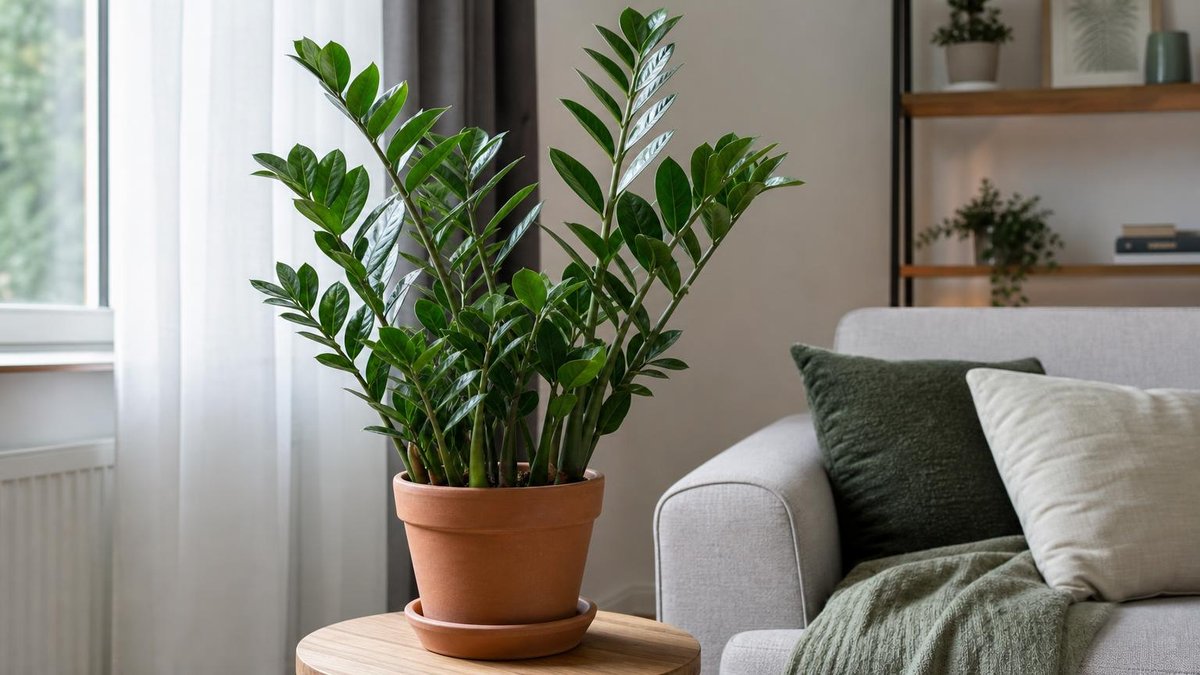
ZZ plant (Zamioculcas zamiifolia) survives abuse that kills fussier houseplants. That waxy, dark green foliage and those thick rhizomatous roots hoard water; skip a month. Skip six weeks in winter. It will not flinch.
The trade-off? It still has limits. Know them, and this tropical perennial outlives your sofa.
Quick care summary
| Factor | Optimal range |
|---|---|
| Light | Bright indirect to low light; tolerates 150-2,500 lux (RHS) |
| Water | When top 5 cm of soil is dry; every 2-3 weeks in growing season |
| Soil | Free-draining potting mix; pH 6.0-7.0 |
| Temperature | 18-24°C (64-75°F); minimum 10°C (50°F) |
| Humidity | Average household humidity; 40-50% adequate |
| Feeding | Balanced liquid fertiliser at half strength, monthly March-September |
Light requirements
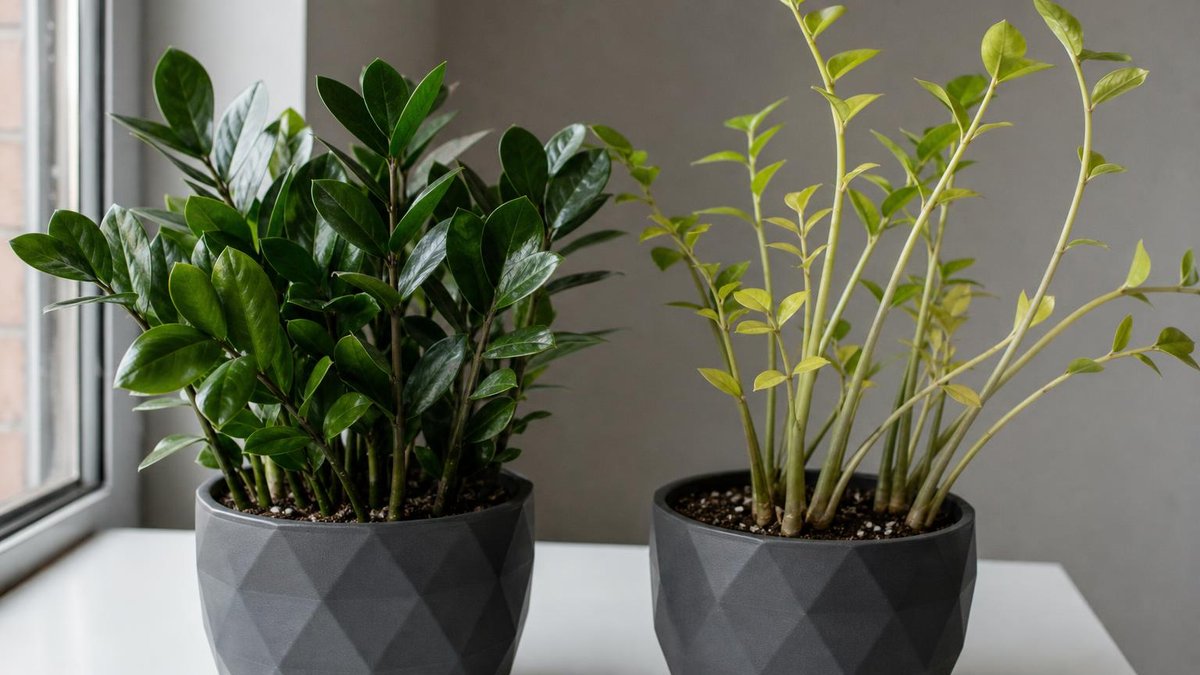
ZZ plant light requirements are flexible, but performance varies significantly with intensity. Near an east or north-facing window, stems grow tighter. Leaflets grow larger. Below 400 lux, the plant stalls. New stems stretch pale and thin, leaves smaller, gaps wider. Direct south or west sun scorches leaflets, causing permanent bleached patches.
The Royal Horticultural Society lists Zamioculcas zamiifolia for “shade to partial shade” indoors. A spot 1-2 metres from glass, or behind sheer curtain, hits the sweet spot. Rotate 90 degrees monthly; stems lean, always.
Watering and root health
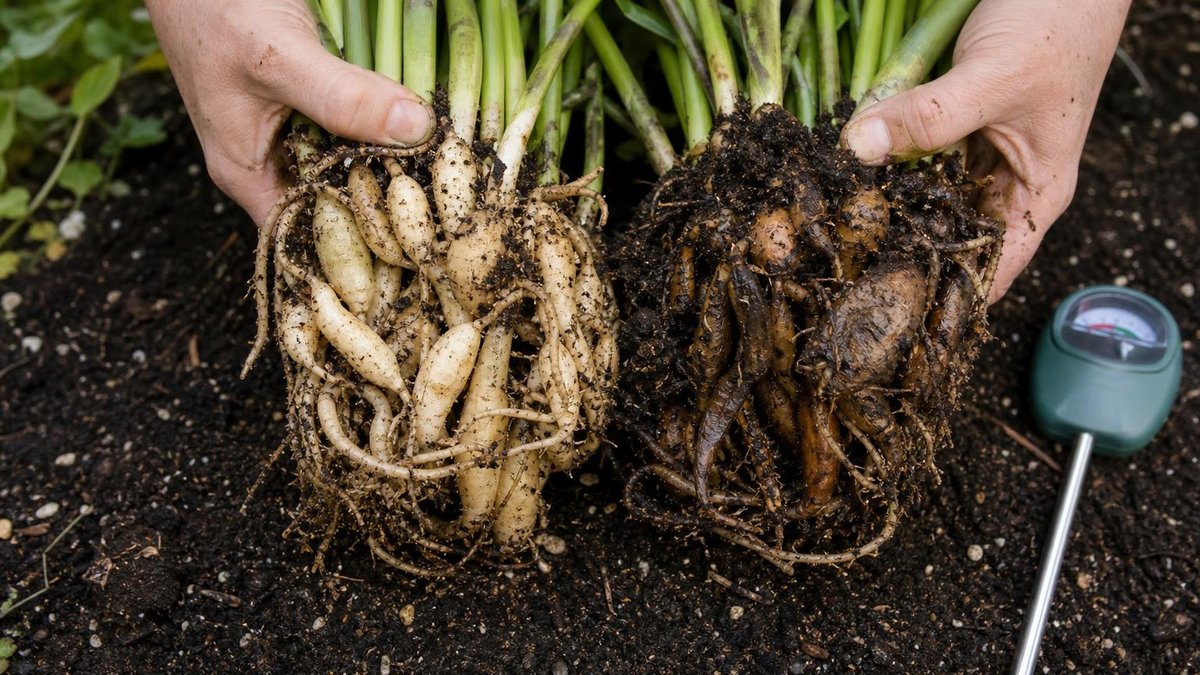
Overwatering kills more ZZ plants than any other factor. The thick, potato-like rhizomes store water for extended drought periods; saturated soil causes anaerobic conditions that trigger rhizome rot. Water only when the top 5 cm of soil feels completely dry to your fingertip, or when a soil moisture meter reads below 3 on a 10-point scale.
Frequency varies seasonally. In spring and summer active growth, expect to water every 14-21 days. In autumn and winter dormancy, extend to every 4-6 weeks. Reduce volume in winter as well; the roots cannot process excess moisture when metabolic activity is low. If you are uncertain whether to water, wait three additional days. The plant tolerates drought far better than saturation.
Yellow, mushy stems at the base indicate advanced root rot. Remove the plant from its pot, trim soft brown rhizomes with sterile shears back to firm white tissue, and repot in fresh dry mix. Withhold water for 7-10 days after this surgery to allow wound callusing. Severe cases with stem collapse require discarding the plant; prevention through proper drainage is the only reliable strategy. Learn to recognise the early warning signs of overwatering before damage becomes irreversible.
Soil and potting
ZZ plant soil mix must drain rapidly while retaining enough structure to support the heavy rhizomes. A blend of two parts peat-free multipurpose compost, one part perlite, and one part coarse horticultural grit provides appropriate porosity. The pH should sit between 6.0 and 7.0; extremes lock out nutrients and damage root hairs.
Container selection affects survival more than most growers recognise. Terracotta pots wick excess moisture through their walls, providing a buffer against overwatering errors. Plastic or ceramic containers require more careful watering discipline. Every pot, regardless of material, needs multiple drainage holes at least 6 mm in diameter. Proper drainage in containers is non-negotiable for this species.
Repot every 2-3 years in early spring, or when roots circle the pot base and emerge from drainage holes. Go up only 2.5-5 cm in diameter. More soil means more wet soil, and wet soil means rot. Rhizomes bruise at a glance; damaged tissue rots fast.
Humidity and temperature
This species originates from dry forest and grassland regions of eastern Africa, from Kenya to northeastern South Africa. Average household humidity between 40-50% suits it perfectly; misting provides no benefit and can encourage bacterial leaf spot on crowded foliage.
18-24°C (64-75°F) keeps growth active. A night at 10°C (50°F) won’t kill it. Sustained cold below that threshold ruptures cell membranes. Blackened leaflets follow, permanent. Keep away from winter draughts, from summer air-con vents. Winter positioning mistakes account for many seasonal losses.
Fertiliser and feeding
ZZ plant fertilizer tips centre on restraint. The species is naturally slow-growing and nutrient-frugal. Apply a balanced liquid feed at half the manufacturer’s recommended strength once monthly from March through September. A 10-10-10 or 20-20-20 formulation provides adequate nitrogen for foliage, phosphorus for root development, and potassium for disease resistance.
Withhold fertiliser entirely in autumn and winter when light levels and temperatures limit metabolic activity. Unused nutrients accumulate as salts, burning root tips and causing marginal leaf scorch. Flush the soil with plain water every fourth watering during the growing season to prevent salt buildup.
Propagation methods
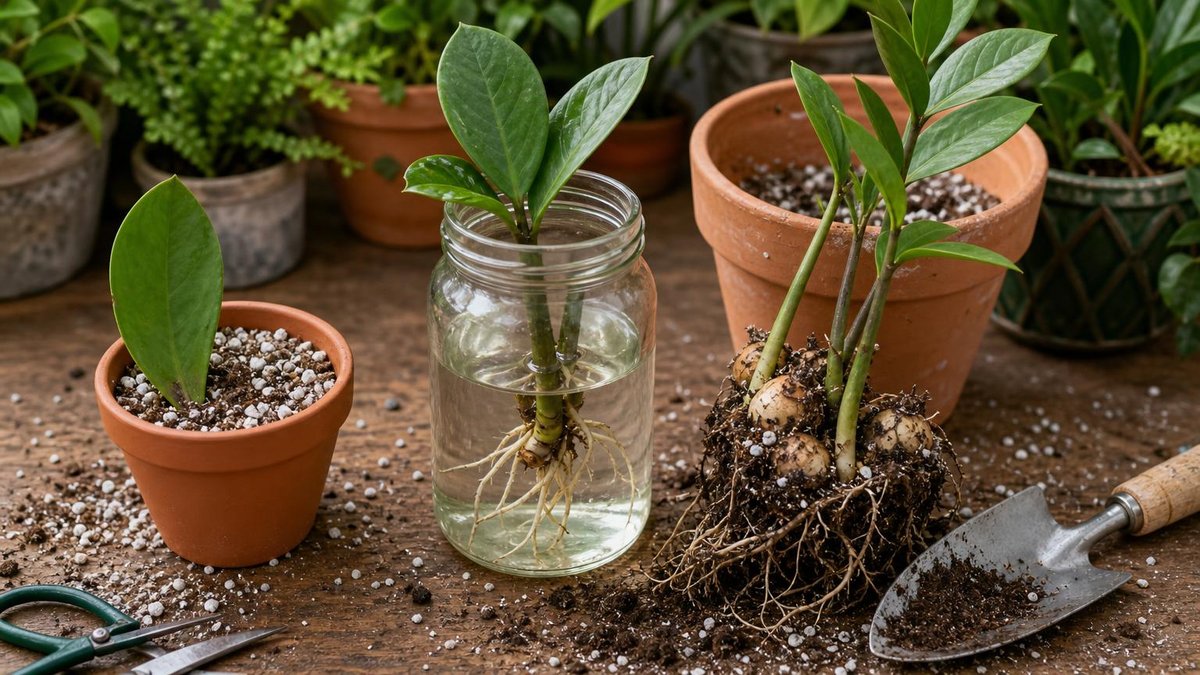
ZZ plant propagation succeeds through three techniques, each with distinct timelines and success rates. Leaf cuttings, stem cuttings, and division all produce viable plants, though patience is essential; this species develops slowly from any starting material.
Leaf cuttings
Remove a healthy leaflet with a small section of petiole attached. Insert the cut end 2-3 cm deep into moist propagation mix of equal parts perlite and coir. Cover with a clear dome; 60-70% humidity, 21-24°C (70-75°F). Roots and a new rhizome form in 6-9 months; the first above-ground shoot may not appear for 12 months.
Stem cuttings
Cut a healthy stem at soil level with sterile secateurs. Remove lower leaflets and place the cut end in water or directly into moist propagation mix. Move water-rooted cuttings to soil at 5 cm root length. Typically 8-12 weeks. Soil-rooted cuttings establish more slowly but avoid transplant shock.
Division
The fastest method for how to propagate a zz plant with immediate results. During repotting, separate the root mass into sections, each with at least one rhizome and attached roots. Replant at the same depth. Water lightly; wait for new growth before resuming normal care. Usually 4-6 weeks.
Popular cultivars
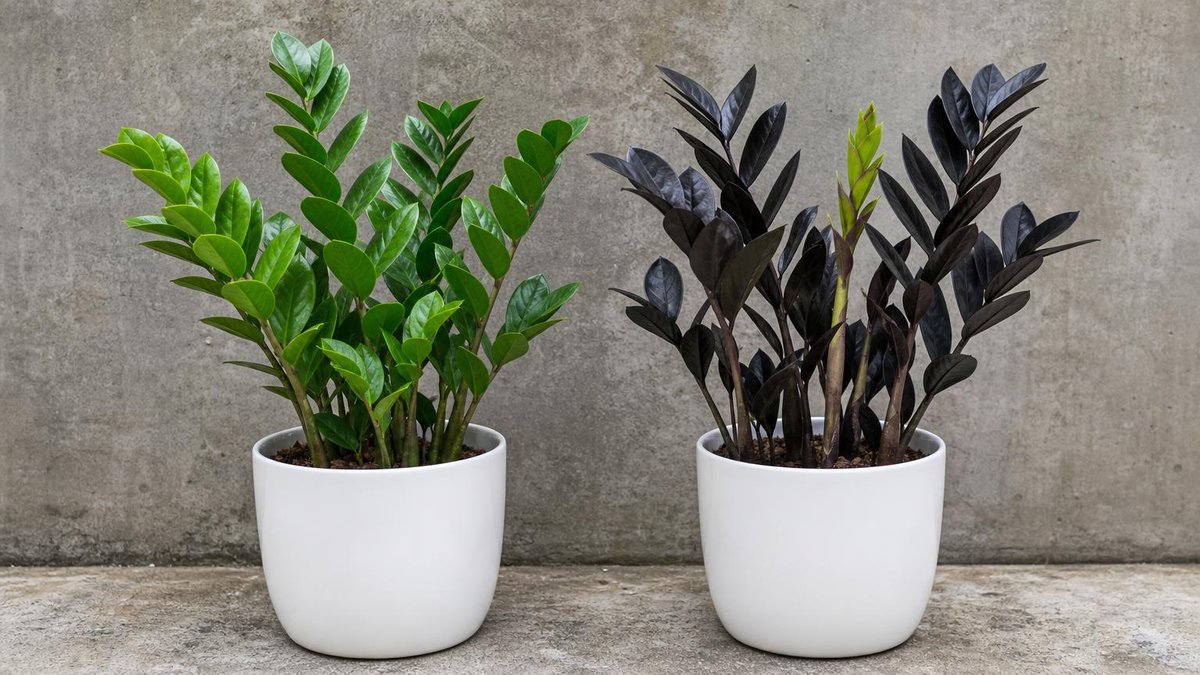
Named varieties exist. ‘Raven’ opens lime green, matures through deep purple to near-black over 2-3 months per leaf. Identical care, different price.
The black zz plant descriptor sometimes refers to ‘Raven’ and sometimes to plants stressed into darkening through high light exposure. True ‘Raven’ maintains stable pigmentation regardless of light intensity. ‘Chameleon’, a newer cultivar, shows more variable colouration with green and bronze tones intermixed, particularly on newer growth.
All cultivars share identical environmental requirements and propagation protocols. Their slower growth rate and patent restrictions in some jurisdictions make them more expensive than the standard form, but no more demanding in cultivation.
Common problems and solutions
ZZ plant yellow leaves fix protocols depend on identifying the correct cause. Yellowing from overwatering begins at the base and progresses upward, with accompanying stem softness. Yellowing from underwatering affects older leaflets first, with crisp rather than mushy texture and no stem involvement.
- Yellow lower leaves, soft stems: overwatering/root rot; reduce frequency, check drainage, repot if necessary
- Yellow older leaflets, dry soil: underwatering; increase frequency modestly
- Brown crispy tips: low humidity or fluoride/chlorine in tap water; use filtered water
- Leaf spots with yellow halos: bacterial or fungal infection; improve air circulation, remove affected tissue, avoid leaf wetting
- Leggy sparse growth: insufficient light; relocate to brighter position
- No new growth for 6+ months: check root health, temperature, and light; may need repotting or fertiliser adjustment
Mealybugs and scale insects occasionally infest stressed plants. Wipe visible pests with cotton wool soaked in 70% isopropyl alcohol, or apply horticultural soap according to label directions. Quarantine new plants for 14 days before placing near established specimens.
Toxicity and pet safety
ZZ plant toxic to cats, dogs, and humans: this is a documented concern requiring clear communication. All plant parts contain calcium oxalate crystals, which penetrate mucous membranes and skin on contact. The ASPCA lists Zamioculcas zamiifolia as toxic to cats and dogs, causing oral irritation, excessive drooling, vomiting, and difficulty swallowing.
Skin contact with sap may cause dermatitis in sensitive individuals. Wear gloves when pruning, propagating, or repotting. Wash hands thoroughly after handling, even with glove use.
If a pet chews foliage, remove plant material from the mouth and offer water. Monitor for persistent vomiting or respiratory distress. Contact your veterinarian or the ASPCA Animal Poison Control Center at 888-426-4435 immediately if symptoms develop beyond mild drooling. Do not induce vomiting without professional guidance.
Human ingestion, particularly by children, causes similar oral burning and gastrointestinal upset. Seek medical attention if swelling affects breathing or swallowing. The plant is not considered lethal at typical exposure levels, but individual reactions vary.
Frequently asked questions
Growing conditions and routine care
How often should I water my ZZ plant?
Water when the top 5 cm of soil is dry, not on a fixed calendar schedule. In practice, this means approximately every 2-3 weeks during spring and summer, and every 4-6 weeks in autumn and winter. Always verify dryness with your finger or a moisture meter before adding water.
Can ZZ plants survive in offices with no windows?
They tolerate fluorescent lighting indefinitely but will not thrive or grow significantly. For long-term health, provide at least 8 hours daily of artificial light at 1,000 lux or more, or relocate to a space with natural light periodically. Growth under purely artificial light remains extremely slow.
Why are my ZZ plant leaves turning yellow?
ZZ plant yellow leaves fix strategies require diagnosing the specific pattern. Base-up yellowing with soft stems indicates overwatering and potential root rot. Tip or edge yellowing suggests salt accumulation or fluoride sensitivity. Uniform yellowing of oldest leaflets is normal senescence; remove these individually.
Propagation and special varieties
How do I propagate a ZZ plant from leaves?
Remove leaflets with a short petiole section, insert 2-3 cm into moist perlite-coir mix, and maintain warm humid conditions. Expect 6-9 months for root and rhizome formation, and up to 12 months for visible new growth. This method demands patience but produces many plants from a single specimen.
Is the raven ZZ plant harder to care for than the green form?
No. The raven zz plant requires identical light, water, soil, and temperature conditions. Its slower growth rate and patent status make it more expensive to purchase, but not more difficult to maintain. Colour development depends on leaf age, not cultivation intensity.
How do I know when to repot my ZZ plant?
Repot when roots emerge from drainage holes, when water runs straight through without saturating the soil, or when the plant has remained in the same container for 3 years. Early spring, before active growth resumes, provides optimal timing. Use minimal pot size increase to prevent moisture retention problems.
Sources
- Royal Horticultural Society. Zamioculcas zamiifolia. RHS Plant Finder. https://www.rhs.org.uk/plants/19598/zamioculcas-zamiifolia/details
- ASPCA. Zamioculcas. Toxic and Non-Toxic Plant List, Cats and Dogs. https://www.aspca.org/pet-care/animal-poison-control/toxic-and-non-toxic-plants/zamioculcas
- Kew Royal Botanic Gardens. Zamioculcas zamiifolia. Plants of the World Online. https://powo.science.kew.org/taxon/urn:lsid:ipni.org:names:97171-1
- Missouri Botanical Garden. Zamioculcas zamiifolia. Plant Finder. https://www.missouribotanicalgarden.org/PlantFinder/PlantFinderDetails.aspx?taxonid=275814
- University of Florida IFAS Extension. ZZ Plant (Zamioculcas zamiifolia). https://gardeningsolutions.ifas.ufl.edu/plants/houseplants/zz-plant.html
