





The single best thing you can do for a Monstera deliciosa before you spend a penny is know what a healthy one looks like – and which questions separate a trustworthy seller from someone shifting stressed stock. Whether you are browsing a specialist nursery, a garden centre, or an online retailer, the same seven questions apply. This guide walks you through each one, with the horticultural reasoning behind it, so you can walk away with a plant that will establish quickly and grow well.
Why the source matters as much as the plant

Monstera deliciosa originates from the tropical forests of southern Mexico and Central America, where it grows as an understorey climber in warm, humid conditions (Royal Botanic Gardens, Kew, 2023). In cultivation, it adapts well to indoor environments, but only when its first weeks in a new home are not compounded by pre-existing stress. A plant that has been underwatered at a wholesale facility, shipped in the dark for five days, or overwatered on a supermarket shelf carries physiological damage that is not always visible at point of sale. Buying from a seller who can answer basic provenance questions is your first filter.
Specialist indoor plant retailers and established nurseries typically source from a smaller number of growers, keep plants for a conditioning period before sale, and have staff who can answer the questions below without hesitation. Large garden centres and supermarkets often receive plants direct from wholesale, with no conditioning period and high turnover staff. That does not make them categorically bad sources – it means you need to rely more heavily on your own visual inspection.
The 7 questions to ask before you buy

1. How long has this plant been in stock?
A Monstera that has been in a retail environment for two to four weeks has had time to acclimatise from the grower’s controlled glasshouse conditions to ambient shop temperature and humidity. One that arrived three days ago is still adjusting. Ask the seller directly. If they cannot tell you, look for a batch sticker or delivery label on the pot. A plant that has been in stock for less than a week carries a higher risk of transplant shock when you move it again – two environmental transitions in rapid succession can suppress root activity for several weeks (RHS, 2022).
2. Where was it grown, and in what conditions?
Commercially, Monstera deliciosa is typically grown in heated glasshouses in the Netherlands, Denmark, or increasingly in nurseries in Spain and Portugal. Plants grown in higher ambient humidity (above 60%) can struggle initially in the drier air of a centrally heated flat. Knowing the origin lets you prepare: if your home sits below 50% relative humidity, a pebble tray with water or a room humidifier will help the plant transition. A seller who knows their grower is a seller worth trusting.
3. What soil mix is it currently in, and when was it last watered?
Monstera roots need oxygen as much as moisture. According to the RHS, a well-draining mix with added perlite or grit is appropriate for aroids – heavy peat-based compost retains water long enough to cause root rot at the base of the stem. Ask what mix the plant is in. If the seller describes standard multipurpose compost with no amendment, factor in an early repot. Watering history matters too: a plant last watered four days ago in a warm shop is probably ready for water; one watered yesterday is not. Learning to use a soil moisture meter before your plant arrives means you will never guess at this again.
4. Does it have any visible pest activity?
Check the underside of every leaf you can reach. Spider mites leave fine webbing at leaf axils and a stippled, silvery texture on the upper surface. Fungus gnats indicate overwatered or poorly draining compost. Scale insects appear as brown or cream raised bumps along stems. Mealybugs present as white cottony clusters at the junction of leaf and petiole. Any infestation is treatable, but bringing an infested plant home risks spreading pests to your existing houseplants. If you see evidence of pests, ask whether the plant has been treated and with what product. An untreated plant with active pest pressure is not worth buying at any price.
5. Are the roots healthy, and can you check them?
A reputable seller will not refuse a gentle root inspection. Healthy Monstera roots are white to pale tan, firm, and slightly fleshy. Brown, mushy roots with a sour odour indicate root rot, most often caused by Phytophthora or Pythium species in waterlogged conditions (RHS Plant Health, 2023). Thin, desiccated roots suggest the plant has been underwatered or root-bound for too long. You are looking for a root system that fills roughly two-thirds of the pot – enough to anchor the plant, but not so compacted that it has nowhere to grow. If the seller refuses to let you look, treat that as useful information.
6. What size and maturity are you actually buying?
Monstera deliciosa produces its characteristic fenestrated leaves only from a certain level of maturity – typically once the plant has produced six or more leaves, though this depends on growing conditions and available light (Kew, 2023). Younger plants sold in 12 cm pots often have entire, un-split leaves, which surprises buyers who expected the iconic look immediately. There is nothing wrong with buying a young plant – they establish easily and are less expensive – but know what you are getting. Ask the seller to confirm the current leaf stage and what light conditions produced it, so you can replicate those at home. If your flat is darker than average, choosing the right plant light may be necessary to sustain fenestration development.
7. What aftercare advice does the seller give without being prompted?
Ask nothing, and see what the seller volunteers. A knowledgeable retailer will typically mention light requirements (bright indirect light, no direct midday sun), watering frequency as a function of soil dryness rather than a fixed schedule, and the importance of not repotting immediately after purchase. If they simply say “water it once a week and keep it out of draughts,” that is a meaningful signal about the depth of their horticultural knowledge. You can still buy the plant – but rely on your own research rather than their aftercare card. A good starting framework is covered in our step-by-step guide to caring for your first apartment plants.
Visual inspection checklist
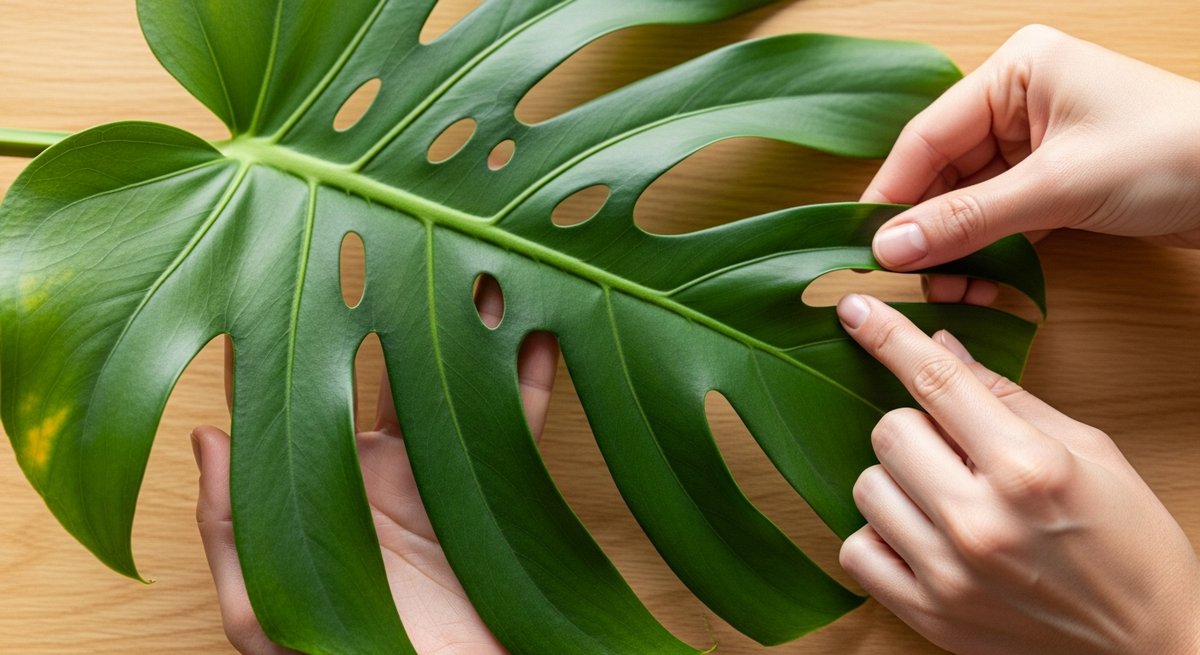
Before asking a single question, run through this visual check. It takes under two minutes and eliminates the worst candidates immediately.
- Leaves are deep green, firm, and upright – not yellowing, limp, or curling at the edges.
- No brown crispy margins (which indicate low humidity or fluoride sensitivity from tap water).
- Stems are firm and green, with no soft or discoloured sections at the base.
- The soil surface is not covered in white crusting (salt accumulation) or green algae (chronic overwatering).
- The pot has at least one drainage hole – Monstera should never sit in standing water.
- The plant is not leaning heavily to one side, which can indicate a compromised root system.
- No webbing, white fluff, or sticky residue on any surface.
Where to buy: a comparison of retail formats
| Retail format | Likely provenance knowledge | Conditioning period | Price range (12 cm pot) | Key risk |
|---|---|---|---|---|
| Specialist indoor plant shop | High | Typically 2-4 weeks | Higher | Higher price; limited geographic availability |
| Established garden centre | Medium | Variable | Mid-range | Stock turnover can be slow; check for neglect |
| Online specialist retailer | Medium to high | Varies by seller | Mid to higher | Transit stress; no pre-purchase inspection |
| Supermarket or DIY store | Low | Usually none | Lower | Erratic watering; pest risk; no specialist staff |
| Private seller (marketplace) | Variable | N/A | Variable | No phytosanitary guarantee; inspect carefully in person |
What to do in the first two weeks after purchase
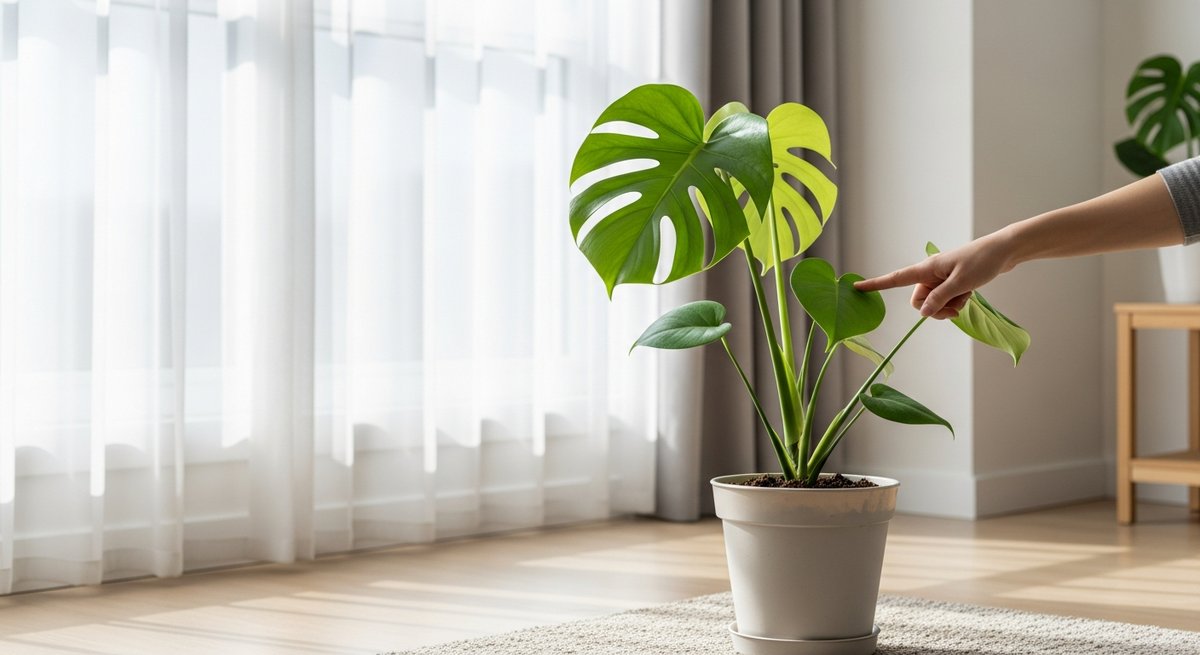
Do not repot immediately. The RHS recommends allowing a newly purchased houseplant to acclimatise to its new light and humidity conditions for at least two weeks before any root disturbance (RHS, 2022). Place the plant in its intended spot and leave it. Water based on the dryness of the top 5 cm of soil – not on a calendar schedule. Keep new purchases away from your existing houseplants for the first two weeks, regardless of how healthy they look at point of sale. Position the plant in bright, indirect light; east or west-facing windows are preferable to north-facing ones. Avoid radiators and draughty window frames, and do not feed in the first four weeks – the roots are not yet established enough to absorb nutrients efficiently, and excess fertiliser salts can cause tip burn. If the plant needs a larger pot after acclimatisation, our guide on repotting without stressing your plants covers the process in full.
Frequently asked questions
Buying and choosing your Monstera
Is it safe to buy Monstera online?
Yes, with caveats. Online specialist retailers who ship in insulated packaging with a moisture-retentive wrap around the rootball are generally reliable. Avoid sellers who cannot describe their packaging method or who offer free standard postal shipping – Monstera does not tolerate being in the dark in a sealed box for more than two to three days. Read recent reviews specifically for plant condition on arrival, not just customer service.
How do I know if a Monstera is root-bound?
Roots emerging through the drainage holes are the clearest sign. You may also notice the soil drying out unusually quickly after watering, or the plant becoming unstable in its pot. A gently root-bound Monstera is not damaged, but it will need repotting within a few months into a pot 3-5 cm larger in diameter.
Why does my new Monstera have no splits in its leaves?
Fenestration develops only as the plant matures and is strongly linked to available light intensity. Young plants with fewer than six leaves rarely show fenestration. In low light, even mature plants can revert to producing smaller, entire leaves. Providing bright indirect light for 8 to 10 hours per day encourages fenestrated growth (Kew, 2023).
Can I buy a Monstera cutting instead of a whole plant?
Yes. A node cutting will propagate reliably in water or a perlite-sphagnum mix. This is a lower-cost entry point and works well if you know the parent plant’s health. The trade-off is time: a cutting typically takes 6 to 12 weeks to produce its first new leaf after rooting. For propagation methods suited to apartment conditions, see our guide to propagating common apartment plants.
Care after purchase
How often should I water a newly bought Monstera?
Water when the top 5 cm of soil is dry. In a centrally heated flat at 18-22°C, this typically means every 7 to 14 days in spring and summer, and every 14 to 21 days in autumn and winter. Adjust based on actual soil dryness, not a fixed interval.
What light does a Monstera need indoors?
Monstera deliciosa performs best in bright, indirect light – ideally 10,000 to 20,000 lux for 8 to 10 hours per day (RHS, 2022). East or west-facing windows typically provide this. Avoid placing the plant within 50 cm of a south-facing window without a sheer curtain, as direct summer sun above 30,000 lux causes bleaching and papery leaf damage.
Is Monstera toxic to pets?
Pet safety notice: Monstera deliciosa is toxic to cats and dogs. All parts of the plant contain insoluble calcium oxalate crystals. According to the ASPCA, ingestion causes oral irritation, intense burning of the mouth, tongue and lips, excessive drooling, vomiting, and difficulty swallowing. If your pet has ingested any part of a Monstera, contact your veterinarian or the ASPCA Animal Poison Control Center immediately on 888-426-4435. Do not wait for symptoms to develop.
When should I repot a Monstera after buying it?
- Wait at least two weeks after purchase before any repotting, to allow acclimatisation.
- Repot only if the plant is visibly root-bound (roots through drainage holes, soil drying in under 5 days).
- Choose a pot 3-5 cm larger in diameter – overpotting increases the risk of root rot.
- Use a well-draining mix: standard houseplant compost amended with 20-30% perlite by volume (RHS, 2022).
- Spring (March to May) is the optimal repotting window, when root growth is most active.
