




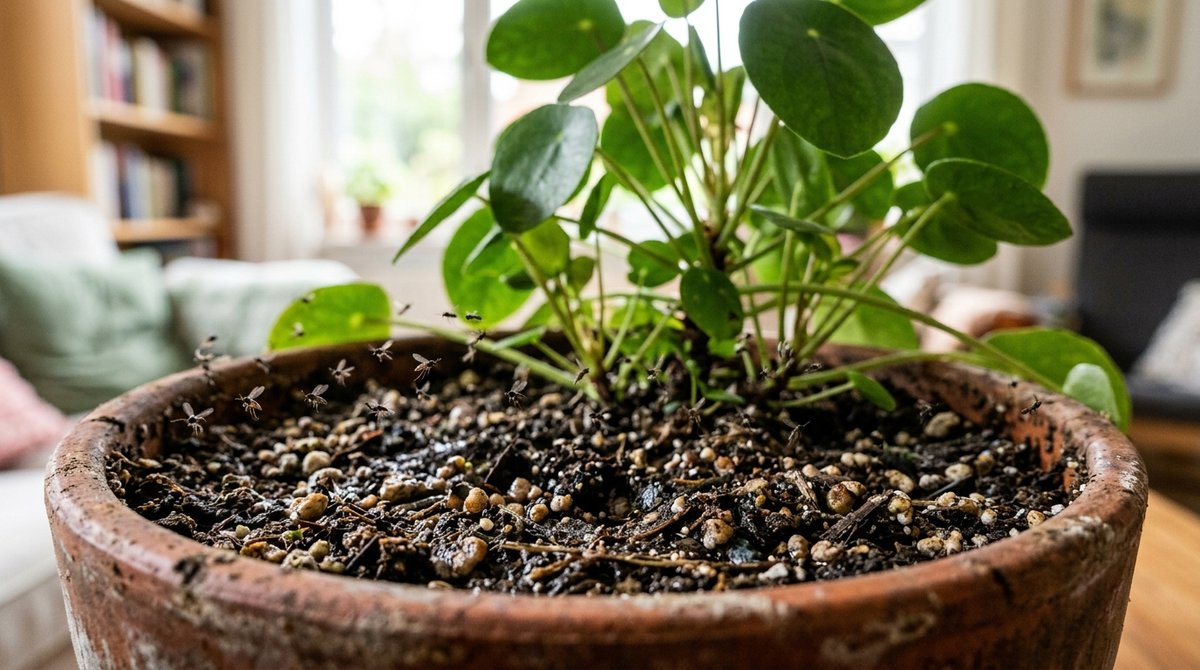
Those tiny flies hovering just above your houseplant soil are almost certainly fungus gnats (family Sciaridae), and the part you can see is only half the problem. The adults are mostly a nuisance; it is the larvae living in the top 5-8 cm (2-3 in) of compost that damage roots, stunt growth, and allow secondary fungal infections to take hold. The good news is that a systematic three-stage approach (dry out the soil, kill the larvae, trap the adults) resolves most household infestations within four to six weeks without professional help.
Fungus gnats vs fruit flies: which pest do you actually have?
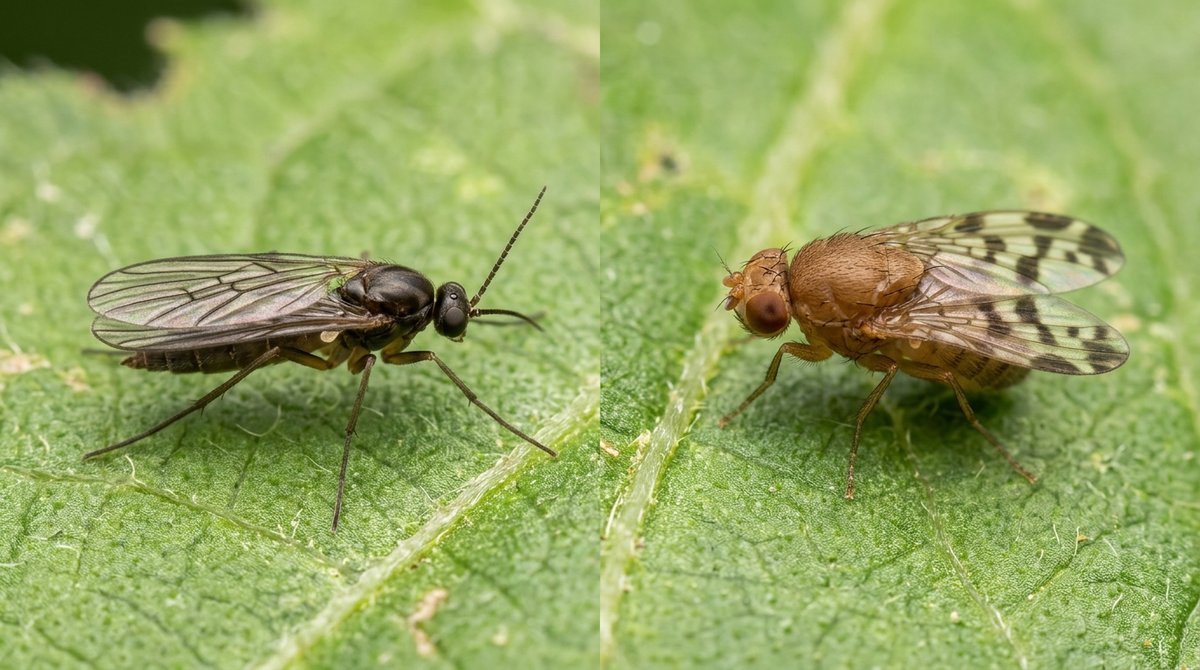
Misidentifying the insect means applying the wrong treatment. The table below summarises the key differences, drawn from University of California IPM and RHS identification guidance.
| Feature | Fungus Gnat | Fruit Fly |
|---|---|---|
| Body length | 2-3 mm (0.08-0.12 in) | 3-4 mm (0.12-0.16 in) |
| Body colour | Dark grey to black; slender | Tan/brown; rounded abdomen |
| Eye colour | Dark | Distinctive red |
| Where found | Around plant soil; attracted to compost | Around overripe fruit, bins, drains |
| Larval habitat | Top 5-8 cm of moist potting mix | Fermenting organic matter; drains |
| Root damage | Yes (larvae feed on roots and fungi) | No |
If the flies cluster near your fruit bowl or sink rather than your pots, treat for fruit flies instead. If they hover over soil and scatter when you water, you have fungus gnats in the house and the treatment plan below applies.
Why fungus gnats thrive in houseplant pots
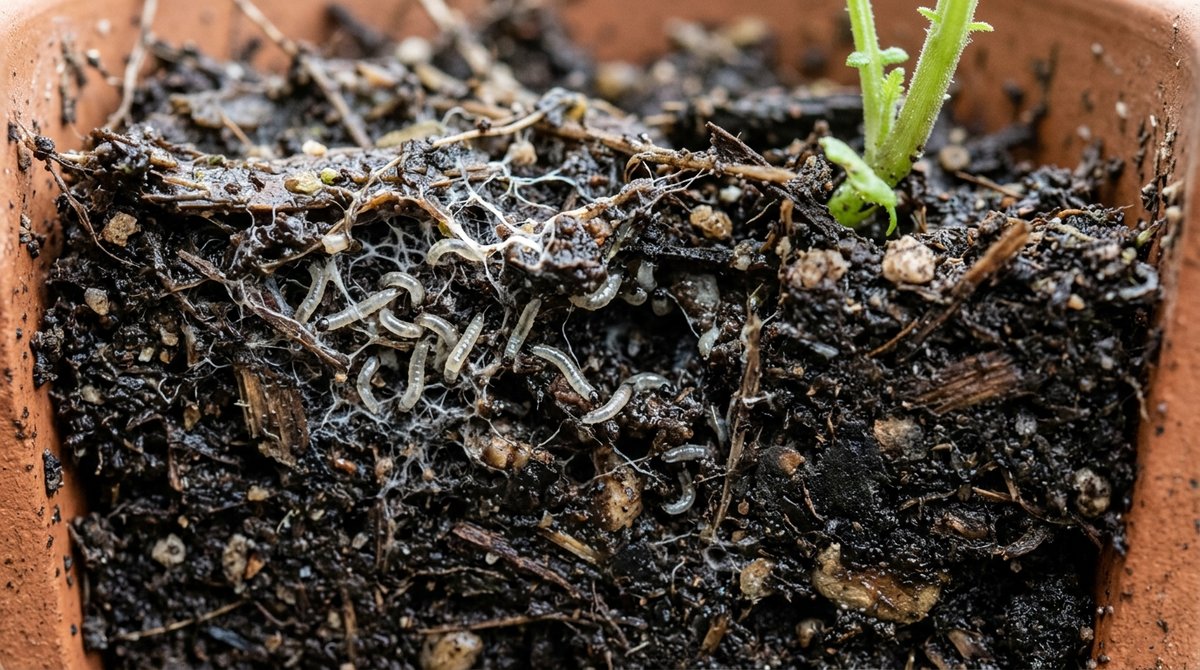
Fungus gnats require two things: moisture and organic matter. Adult females lay 100-200 eggs in the top few centimetres of moist potting compost. Those eggs hatch in four to six days at 21°C (70°F), and the larvae spend the next 12-14 days grazing on fungal hyphae, decaying organic matter, and, when populations are high, living root tissue. Rich, peat-based mixes that retain moisture for extended periods are the preferred habitat. Switching to a more free-draining medium is one of the most effective long-term controls, which is why choosing the right soil for your indoor plants matters beyond just nutrition.
Do fungus gnats bite?
No. Adult fungus gnats do not have mouthparts capable of biting humans or pets (UC IPM, 2023). They are a plant health problem, not a human health risk. The irritation people feel near an infestation is usually the perception of insects flying close to the face, not any physical bite.
How to kill fungus gnats: a staged treatment plan
Stage 1: Cut off the moisture supply
Water only when the top 5 cm (2 in) of compost is completely dry. This is not about stressing the plant; it is about making the soil surface inhospitable to egg-laying females, which require moisture to lay viable eggs (RHS, 2024). Most infestations reduce measurably within two weeks of consistent surface-drying alone. Remove any standing water from saucers within 30 minutes of watering.
Stage 2: Treat the larvae in the soil
Drying alone rarely eliminates an established population. Use one or more of the following larval treatments:
- Bacillus thuringiensis var. israelensis (Bti), sold as Mosquito Bits: Bti is a naturally occurring soil bacterium that produces proteins toxic specifically to fly and mosquito larvae. Soak Mosquito Bits in water for 30 minutes, strain out the granules, and use the cloudy water to drench the soil. Apply every seven days for three to four weeks. Bti has no effect on earthworms, beneficial insects, pets, or humans (EPA registration confirmed). Mosquito Bits for fungus gnats must be reapplied repeatedly; a single drench will not clear a heavy infestation.
- Hydrogen peroxide soil drench: Mix one part 3% hydrogen peroxide with four parts water and apply until it drains from the pot base. The peroxide releases oxygen on contact with organic matter, killing larvae on contact, and breaks down to water within minutes (UC IPM, 2023). Limit use to two to three applications per pot to avoid reducing beneficial soil microbes.
- Beneficial nematodes (Steinernema feltiae): These microscopic roundworms actively hunt fungus gnat larvae in the soil. Apply as a drench at 50,000 nematodes per litre of water. Soil temperature must be above 10°C (50°F) for nematodes to be active, and they should be used within two hours of mixing.
Stage 3: Trap the adults
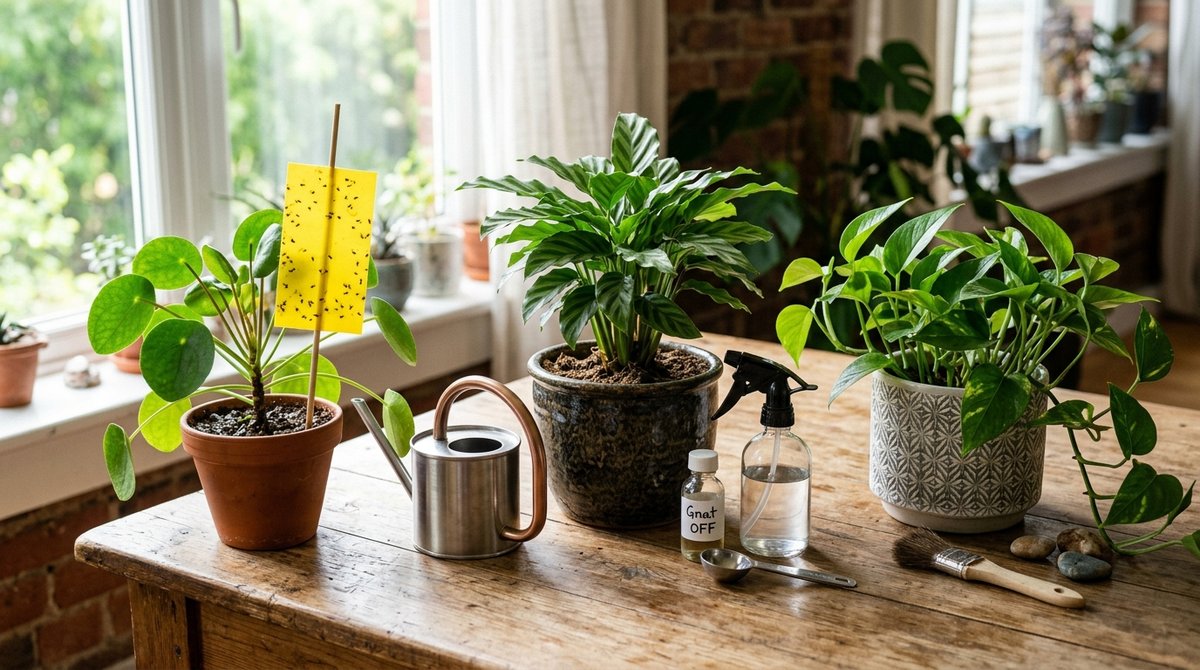
Adults live for only about seven to ten days (RHS, 2024), so trapping prevents new egg-laying while your soil treatment works through the larval population. Yellow sticky traps placed at soil level are the most effective placement because adults fly low. Place one 10 x 25 cm (4 x 10 in) trap per pot, and check and replace every seven days. If trap catches drop to fewer than five adults per week, the infestation is under control.
For a broader look at non-chemical approaches, see our guide to natural remedies for indoor plant pests.
Symptom, cause, and fix reference
| Symptom | Most likely cause | Fix |
|---|---|---|
| Adults flying near pots but plant looks healthy | Early infestation; root damage minimal | Begin surface-drying and Bti drench immediately |
| Wilting or yellowing despite adequate watering | Larval root feeding disrupting water uptake | Hydrogen peroxide drench + Bti + assess root health on repotting |
| Translucent larvae visible in top 5 cm of soil | Active larval stage confirmed | Immediate Bti or nematode drench; increase sticky trap count |
| Stunted new growth; roots appear brown and sparse | Severe root damage from high larval density | Repot into fresh, sterile compost after treating existing root ball |
When to repot rather than treat
If sticky traps still catch more than 20 adults per week after four weeks of consistent treatment, or if root inspection reveals widespread brown rot, repotting into fresh, sterile compost is more effective than continuing to treat the existing mix. Remove as much of the old compost as possible, rinse the root ball under tepid water, and pot into a free-draining mix. Our guide on how to repot indoor plants covers correct pot sizing to avoid the excess moisture retention that makes recurrence more likely.
Preventing recurrence
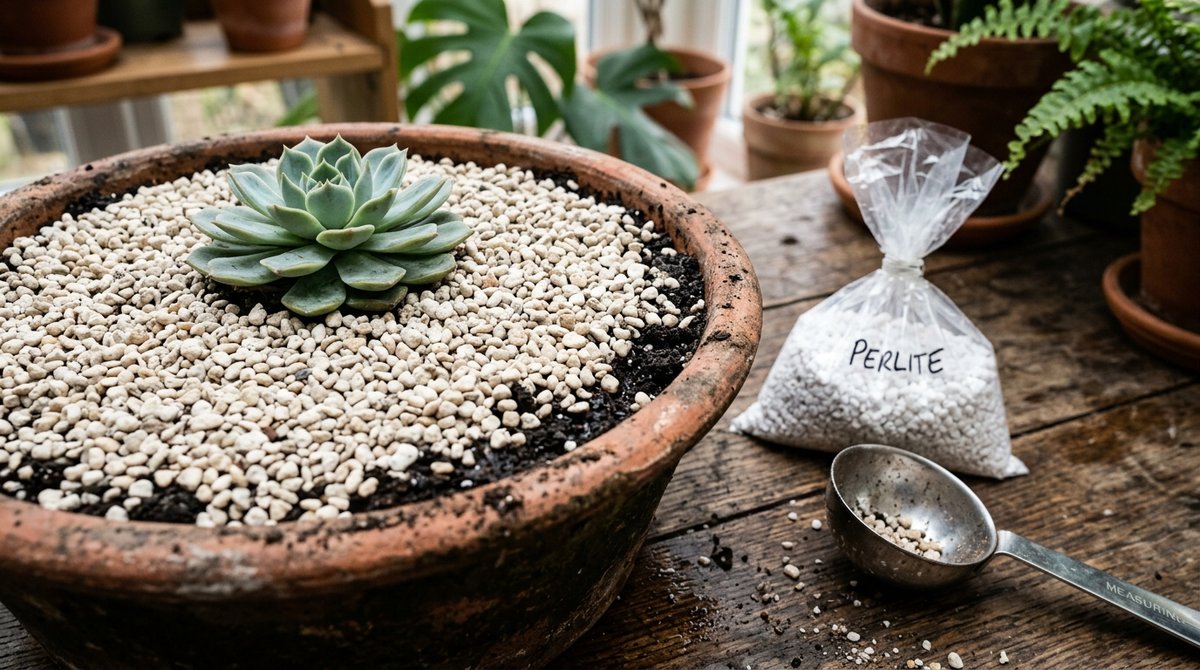
- Use a well-draining compost with 20-30% perlite by volume to reduce moisture retention (RHS guidance on growing media).
- Apply a 1-2 cm (0.4-0.8 in) layer of horticultural grit or coarse sand to pot surfaces; females cannot easily lay eggs through a dry, abrasive top-dressing.
- Never allow pots to sit in standing water for more than 30 minutes after watering.
- Quarantine any new houseplant for two weeks before placing it near existing plants.
- Keep one or two yellow sticky traps in place year-round as an early detection tool.
Frequently asked questions
How long does it take to get rid of fungus gnats completely?
Expect four to six weeks from the start of treatment to zero adult catches on sticky traps. Eggs hatch in four to six days, larvae feed for 12-14 days, and pupation takes a further three to six days before adults emerge (UC IPM, 2023). Treatment must run long enough to break every stage of the cycle.
Is the hydrogen peroxide drench safe for my plant’s roots?
A solution of one part 3% hydrogen peroxide to four parts water is generally safe for most established houseplants when applied no more than three times per affected pot. Avoid stronger concentrations; solutions above 3% can cause chemical burn to root tissue (UC IPM, 2023).
How do Mosquito Bits work against fungus gnats?
Mosquito Bits contain Bti, which produces delta-endotoxin proteins. When fungus gnat larvae ingest these proteins, the toxins bind to receptors in the larval gut wall, causing cellular disruption and death within 24-48 hours. The proteins are species-specific to dipteran larvae and are non-toxic to vertebrates and most invertebrates (EPA, Bti registration documents).
Why do I keep getting fungus gnats even after treating?
- The compost is retaining moisture too long; consider adding perlite or switching to a more free-draining mix.
- New plants or compost introduced after treatment brought in fresh eggs.
- Treatment was stopped before the full four to six week cycle was broken.
- A secondary moisture source (overflowing drip trays, leaking pipes) is sustaining the population independently of your watering habits.
Do fungus gnats spread from plant to plant?
Yes. Adult females fly freely between pots in search of moist compost. A single heavily infested pot can seed neighbouring plants within one to two adult generations (roughly three to four weeks). Isolate any visibly infested plant immediately and treat all pots in the same room simultaneously. Our article on how to prevent pest infestations in apartment plants covers quarantine protocols and soil selection that make your growing environment less hospitable to fungus gnats before they establish.
Sources
- University of California Integrated Pest Management Programme (UC IPM), 2023. “Fungus Gnats”. https://ipm.ucanr.edu/PMG/PESTNOTES/pn7448.html
- Royal Horticultural Society (RHS), 2024. “Fungus gnats (sciarid flies)”. https://www.rhs.org.uk/biodiversity/fungus-gnats
- US Environmental Protection Agency (EPA), Bti Registration Eligibility Decision, 1998. “Bacillus thuringiensis”. https://www.epa.gov/ingredients-used-pesticide-products/bacillus-thuringiensis
- Royal Horticultural Society (RHS), 2024. “Potting composts”. https://www.rhs.org.uk/soil-composts-mulches/composts
