




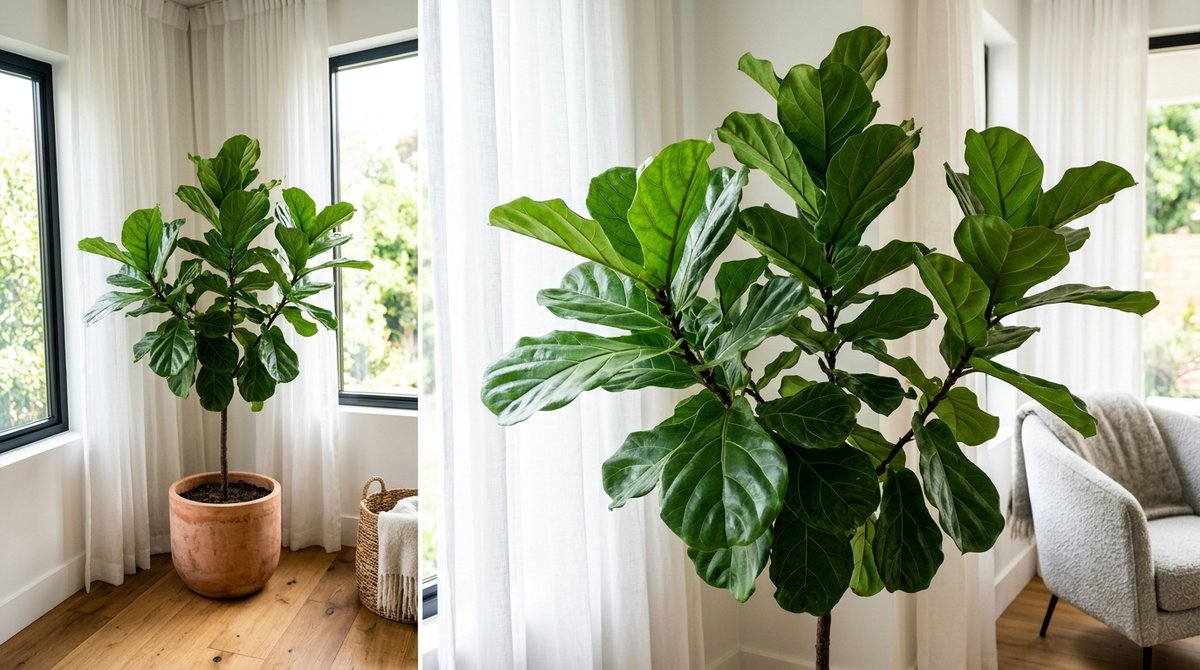
Ficus lyrata, the species behind every fiddle leaf fig tree sold in garden centres, is native to the lowland rainforests of West Africa. In the home, it is notorious for dropping leaves at the first sign of environmental stress. The plant does not adapt gradually; it responds immediately to changes in light, water, or root space. Success with this species comes from setting conditions correctly from the start and then changing them as little as possible.
This guide covers the measurable requirements for keeping a fiddle leaf fig plant healthy: light intensity, watering thresholds, soil structure, temperature and humidity ranges, feeding schedules, and the specific causes of the most common problems.
Quick care summary
The figures below are drawn from Royal Horticultural Society cultivation guidance for Ficus lyrata and Kew’s Plants of the World Online database.
| Factor | Optimal range or condition |
|---|---|
| Light | Bright, indirect light; 6+ hours daily; 1,000-2,000 foot-candles (10,800-21,500 lux) |
| Water | When top 5cm (2in) of soil is dry; reduce by half in winter |
| Soil | Free-draining, peat-free mix; pH 6.0-6.5 |
| Temperature | 16-24°C (61-75°F); minimum 10°C (50°F) |
| Humidity | 40-60% relative humidity |
| Feeding | Balanced liquid fertiliser, half-strength, every 2-4 weeks in growing season |
| Repotting | Every 2-3 years, or when roots circle the pot base |
Light requirements
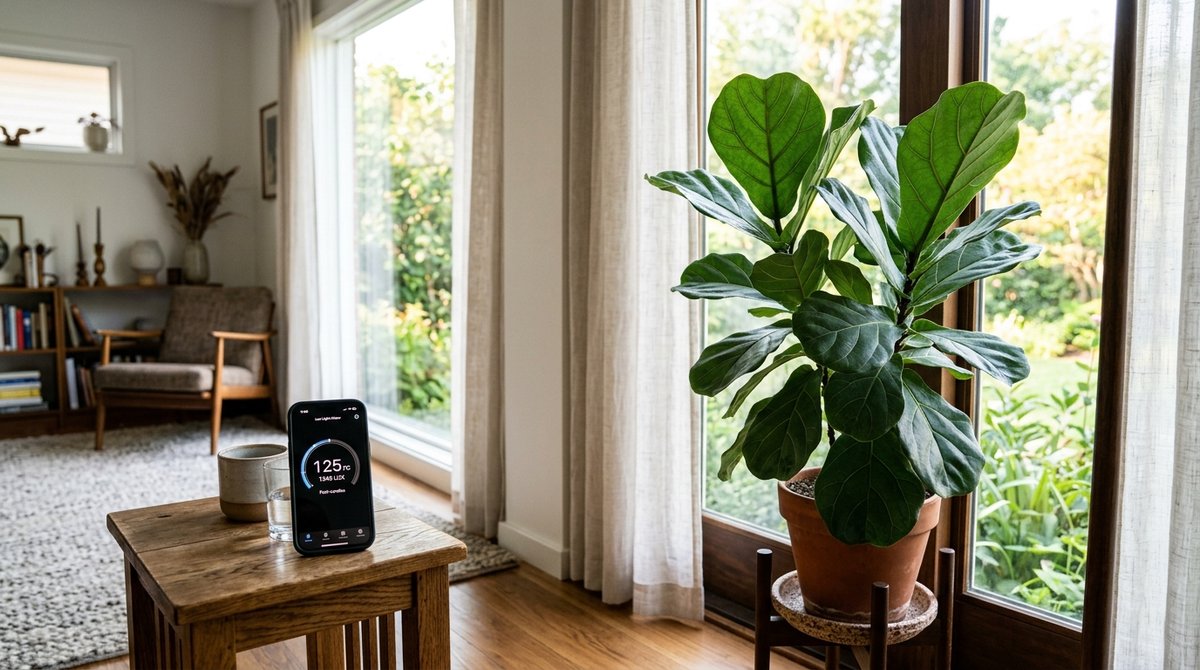
Fiddle leaf fig light requirements are the most commonly misunderstood aspect of its care. Forget the “low-light tolerant” label on shop tags. Juvenile plants in the wild start as canopy epiphytes; the light is filtered, but it is intense equatorial light, not the dim corner of a living room. Mature trees punch through the canopy into full sun.
At home, put it 1-2 metres (3-6 feet) from a south- or west-facing window.
East windows suffice in summer. In winter, above 50°N, they fall short. North windows will not work without supplementation: 2,000-4,000 lumens from grow lights, 12-14 hours daily.
Below 800 foot-candles (8,600 lux), stems stretch, leaves shrink, the plant goes leggy. Direct midday sun through glass scorches leaves, especially on plants fresh from shaded shops. Increase exposure by 30 minutes daily over 7-10 days.
Turn the pot 90° every two weeks. Ficus lyrata is aggressively phototropic; leave it static and it leans, then topples.
Watering
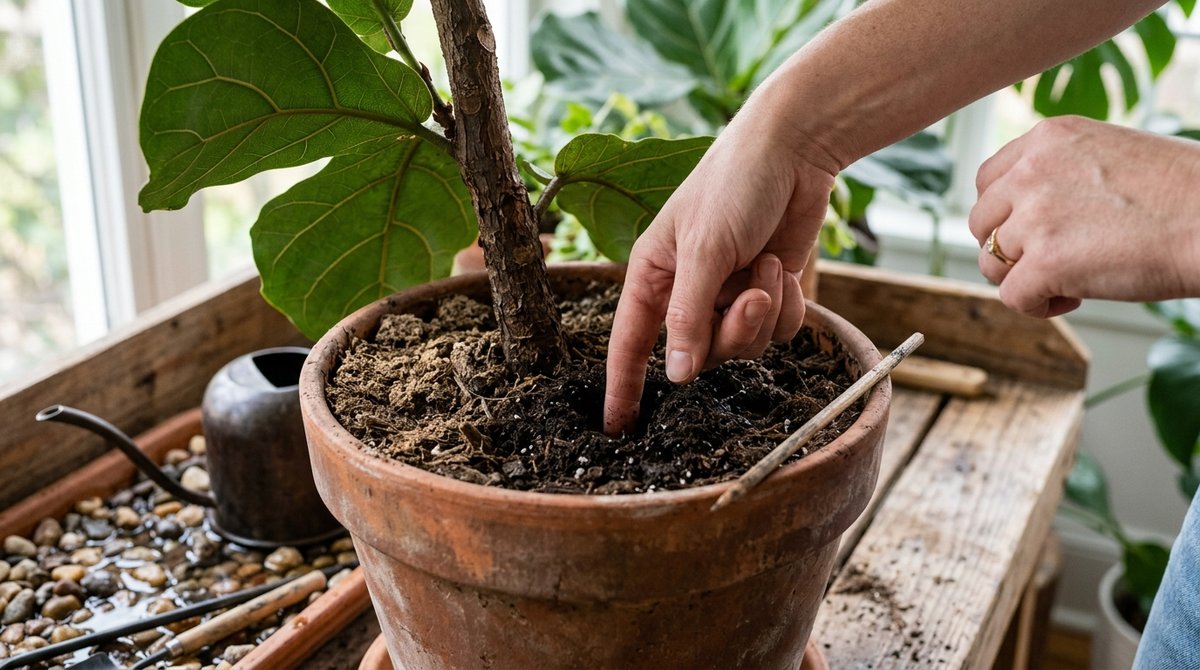
The correct fiddle leaf fig watering schedule depends on seasonal growth patterns, not calendar dates. From March to September, water when the top 5cm (2in) of soil has dried completely. In winter dormancy, extend this interval; the root system is metabolically inactive and cannot process excess moisture.
Use your finger to test soil moisture at 5cm depth, or use a moisture meter for more precision. Soil moisture meters remove guesswork and are particularly useful for large pots where the surface dries faster than the root ball.
Water until 10-15% of the volume drains from the bottom. Discard drainage water after 30 minutes; never let the pot stand in water. Ficus lyrata roots are susceptible to hypoxia and Phytophthora root rot when waterlogged.
Signs of incorrect watering are specific:
- Overwatering: Lower leaves yellow uniformly, then develop dark brown, soft spots at the margins. Roots turn brown and mushy when examined.
- Underwatering: Leaves droop, then crisp from the tip inward. Edges turn tan and papery. The plant recovers within 24 hours of correct watering if caught early.
Use room-temperature water. Cold water shocks the root system and causes leaf drop in sensitive specimens.
Soil and potting
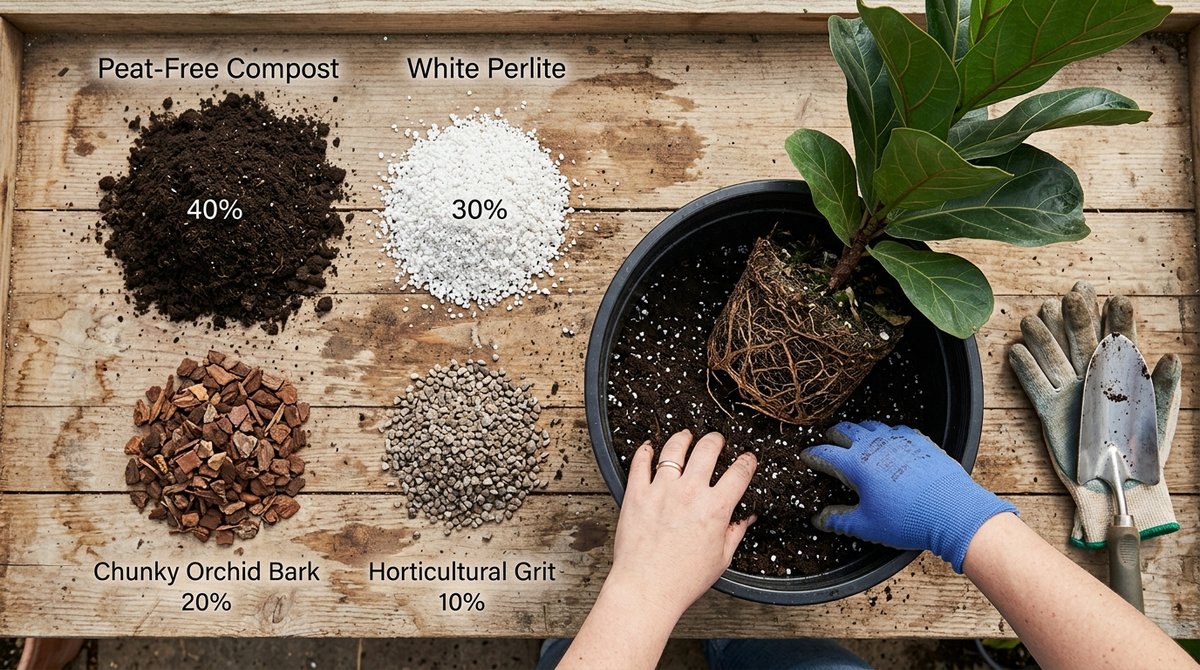
The best soil for fiddle leaf fig drains fast, contains no peat, and holds just enough moisture that roots do not desiccate between waterings.
Mix it yourself:
- 40% high-quality peat-free potting compost
- 30% perlite or pumice for aeration
- 20% orchid bark for structural drainage
- 10% horticultural grit or coarse sand
Organic matter feeds and retains moisture; mineral content stops compaction. pH 6.0-6.5. Test before planting.
Repot every 2-3 years in early spring. Sooner if roots escape drainage holes or circle the base. The new pot: only 5-7cm (2-3in) wider. More soil means more water held, means more rot. Repotting indoor plants correctly minimises transplant shock, which in Ficus lyrata manifests as total leaf drop within 48 hours.
Always use pots with drainage holes. Self-watering pots and decorative cachepots without drainage are unsuitable for this species.
Temperature and humidity
Maintain temperatures between 16-24°C (61-75°F) year-round. The absolute minimum is 10°C (50°F); brief exposure below this threshold causes chilling injury, characterised by dark, water-soaked lesions on leaves that later desiccate. Keep plants away from draughts, including air conditioning vents, radiator convection currents, and frequently opened exterior doors.
Relative humidity of 40-60% prevents the leaf edge browning that plagues many specimens in centrally heated homes. Increase humidity by grouping plants, placing the pot on a pebble tray filled with water (the pot base must sit above the waterline), or using a humidifier. Misting is ineffective; it raises humidity for minutes only and can encourage bacterial leaf spot if foliage remains wet overnight.
Winter plant care requires particular attention to humidity, as heating systems typically reduce indoor relative humidity to 20-30%.
Feeding
Feed with a balanced liquid fertiliser (NPK 10-10-10 or 20-20-20) at half the manufacturer’s recommended strength, applied every 2-4 weeks from March to September. Over-fertilisation causes tip burn and root damage; the species is not a heavy feeder.
Withhold fertiliser entirely in autumn and winter. The plant cannot metabolise nutrients during dormancy, and accumulated salts in the soil cause root tip necrosis. Flush the soil with plain water every third watering during the growing season to prevent salt buildup.
Pruning and shaping
Fiddle leaf fig pruning tips centre on timing and technique. Prune only in early spring, when the plant has maximum vascular activity and can seal wounds quickly. Use clean, sharp bypass secateurs sterilised with 70% isopropyl alcohol. Cut 5mm (0.25in) above a leaf node at a 45° angle.
Remove no more than 20% of total leaf area in a single session. Hard pruning triggers dormant lateral buds and can produce bushier growth, but it also stresses the plant significantly. Plants pruned too heavily may drop remaining leaves and enter a recovery period of 2-3 months.
To encourage branching on a single-stem specimen, notch the trunk above a dormant bud. Make a shallow, angled cut through the bark without penetrating the cambium layer. This interrupts auxin flow and stimulates lateral growth. Success rate is approximately 60-70%.
Propagation
Those researching how to propagate fiddle leaf fig should understand that the species roots reluctantly from cuttings compared to Ficus elastica or Ficus benjamina. Success requires precise conditions.
Take stem cuttings 15-20cm (6-8in) long with 2-3 leaves in spring. Remove the lowest leaf and dip the cut in rooting hormone powder (0.1% IBA concentration). Insert into a mix of 50:50 perlite and peat-free compost, or root in water with the base submerged 3-5cm (1-2in).
Water-propagated cuttings develop water roots that must transition to soil roots; this transition fails in 30-40% of specimens. For higher success, use a propagation chamber with bottom heat at 21-24°C (70-75°F) and humidity above 70%. Rooting takes 6-10 weeks. Do not tug-test before 8 weeks; disturbance severs developing root initials.
Common problems and their causes
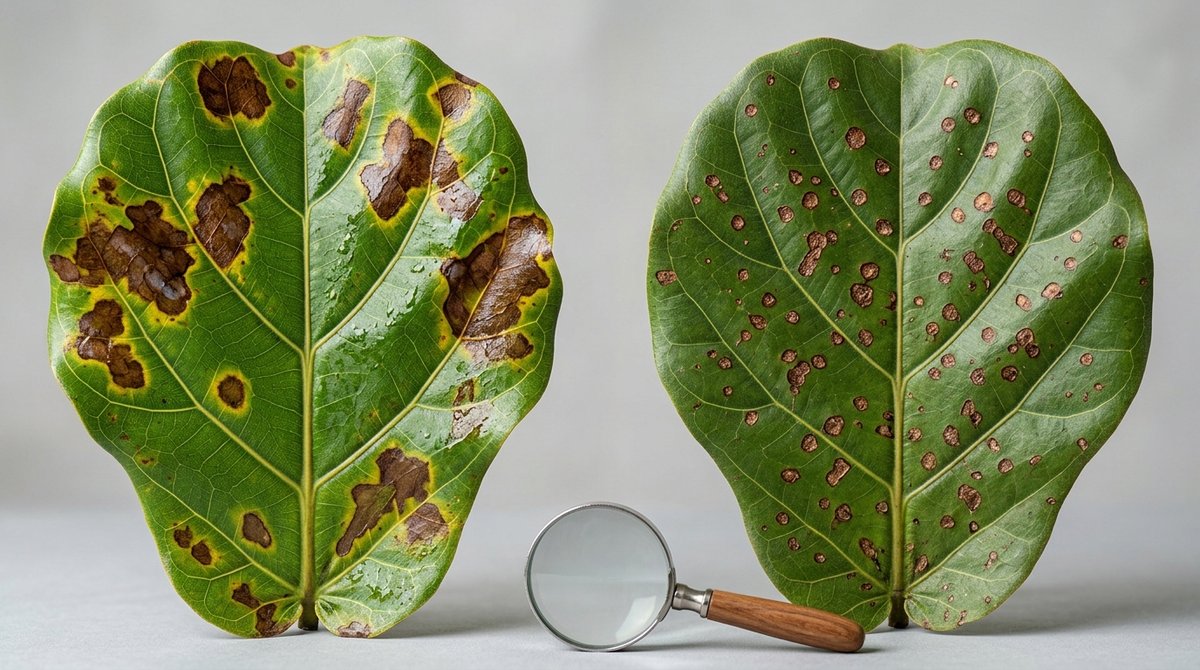
Fiddle leaf fig brown spots are the symptom that generates the most anxious queries. The cause is specific and diagnosable by spot appearance and location.
| Symptom pattern | Most likely cause | Corrective action |
|---|---|---|
| Large, irregular brown spots with yellow halos, spreading from leaf margins inward | Bacterial leaf spot (Xanthomonas campestris) | Remove affected leaves with sterile tools; reduce leaf wetness; copper-based bactericide if severe |
| Small, circular tan spots with dark borders, often on lower leaves first | Cercospora leaf spot (fungal) | Improve air circulation; remove infected tissue; fungicide containing chlorothalonil |
| Brown spots starting at leaf centre, soft and dark, with yellowing of entire leaf | Root rot (Phytophthora or Pythium) | Unpot, trim brown roots to healthy white tissue; repot in fresh, sterile mix; reduce watering frequency |
| Dry, crispy brown edges starting at leaf tip, no yellow halo | Low humidity or underwatering | Increase humidity to 50%+; check soil moisture at 5cm depth before watering |
| Pale, bleached patches on upper leaf surfaces | Sun scorch | Move to indirect light; acclimate gradually if increasing exposure |
Leaf drop without spotting indicates environmental shock: temperature fluctuation, repotting trauma, or relocation. The plant may shed 50% or more of its foliage and still recover if conditions stabilise. Do not increase watering or feeding in response to leaf drop; this compounds the stress.
Indoor plant diseases can spread between specimens; isolate any plant showing symptoms and sterilise tools between plants.
When to call a professional
Contact a qualified arborist or plant health consultant if:
- Root rot has destroyed more than 50% of the root system
- The main trunk is soft or weeping sap at the base, indicating collar rot
- Bacterial leaf spot has spread to more than 30% of leaf area despite intervention
- The plant exceeds 2m (6.5ft) and requires structural pruning for safety
Do not attempt to save severely compromised specimens through increased care. Overwatering a plant in root rot decline accelerates mortality.
Toxicity and pet safety
Ficus lyrata contains ficin, a proteolytic enzyme, and ficusin, a psoralen compound. These are irritants rather than systemic toxins, but ingestion causes significant discomfort. The ASPCA lists Ficus species as toxic to cats and dogs.
Symptoms of ingestion include oral irritation, excessive drooling, vomiting, and dermatitis from contact with sap. The sap itself is a skin irritant in humans; wear gloves when pruning or handling broken stems.
If a pet chews leaves or shows symptoms, contact your veterinarian immediately. For emergency guidance, call ASPCA Animal Poison Control at 888-426-4435 (US; fee may apply).
Frequently asked questions
Care and troubleshooting
Why does my fiddle-leaf fig keep dropping leaves?
Leaf drop in Ficus lyrata is almost always a response to environmental change: moved location, temperature swing, repotting, or inconsistent watering. Check for draughts, verify soil moisture at 5cm depth is neither constantly wet nor bone-dry, and ensure light levels exceed 800 foot-candles. Stabilise conditions and wait 4-6 weeks; new growth indicates recovery.
How often should I water my fiddle leaf fig?
Water when the top 5cm (2in) of soil is dry. In practice, this means approximately every 7-10 days in summer and every 14-21 days in winter for a plant in a 25cm (10in) pot in average household conditions. Use a moisture meter or finger test rather than a calendar. The fiddle leaf fig watering schedule that works is the one that responds to actual soil conditions, not the day of the week.
What causes brown spots on fiddle leaf fig leaves?
Brown spots on fiddle leaf fig leaves have distinct causes diagnosable by appearance and progression. Dark, soft spots with yellow halos spreading from margins indicate bacterial infection. Dry, crispy edges indicate low humidity or underwatering. Centre-starting soft browning with overall yellowing signals root rot. Accurate diagnosis requires matching the symptom pattern to the cause.
Growth and maintenance
How do I make my fiddle leaf fig bushier instead of taller?
Encourage lateral branching by pruning the apical (top) growth point in early spring. Cut 5mm above a leaf node. This removes the auxin source that suppresses side buds. Alternatively, notch the trunk above a dormant bud without removing the growing tip. Both methods stress the plant; provide stable conditions and avoid fertilising for 4 weeks afterward.
Can I propagate a fiddle leaf fig from a single leaf?
Single-leaf cuttings root in water but rarely produce new growth. The leaf develops roots and may survive for months, yet without stem tissue containing a dormant bud, it cannot generate a shoot system. For viable propagation, use a stem cutting with 2-3 leaves and at least one node.
Should I choose a real or faux fiddle leaf fig tree?
A faux fiddle leaf fig tree requires no light, water, or humidity management and carries no toxicity risk. However, it provides no air purification and no responsive growth to care. Choose artificial if your space lacks adequate light or if you travel frequently. Choose the living plant if you can provide 6+ hours of bright indirect light and consistent care; the species rewards stability with dramatic architectural presence.
When is the best time to repot?
Repot in early spring, March to April in the Northern Hemisphere, when root growth resumes. This timing gives the plant a full growing season to establish in fresh substrate before winter dormancy. Repotting in autumn places a root-damaged plant into low-light, low-temperature conditions where recovery is slow and root rot risk is elevated.
Sources
- Royal Horticultural Society. (2024). Ficus lyrata: Fiddle-leaf fig. https://www.rhs.org.uk/plants/37172/ficus-lyrata/details
- Royal Botanic Gardens, Kew. (2024). Ficus lyrata. Plants of the World Online. https://powo.science.kew.org/taxon/urn:lsid:ipni.org:names:852482-1
- ASPCA. (2024). Ficus: Toxic to dogs, cats, and horses. https://www.aspca.org/pet-care/animal-poison-control/toxic-and-non-toxic-plants/ficus
- Missouri Botanical Garden. (2024). Ficus lyrata. Plant Finder. https://www.missouribotanicalgarden.org/PlantFinder/PlantFinderDetails.aspx?taxonid=279702
- University of Florida IFAS Extension. (2019). Ficus lyrata: Fiddleleaf fig. https://edis.ifas.ufl.edu/publication/FP230
