




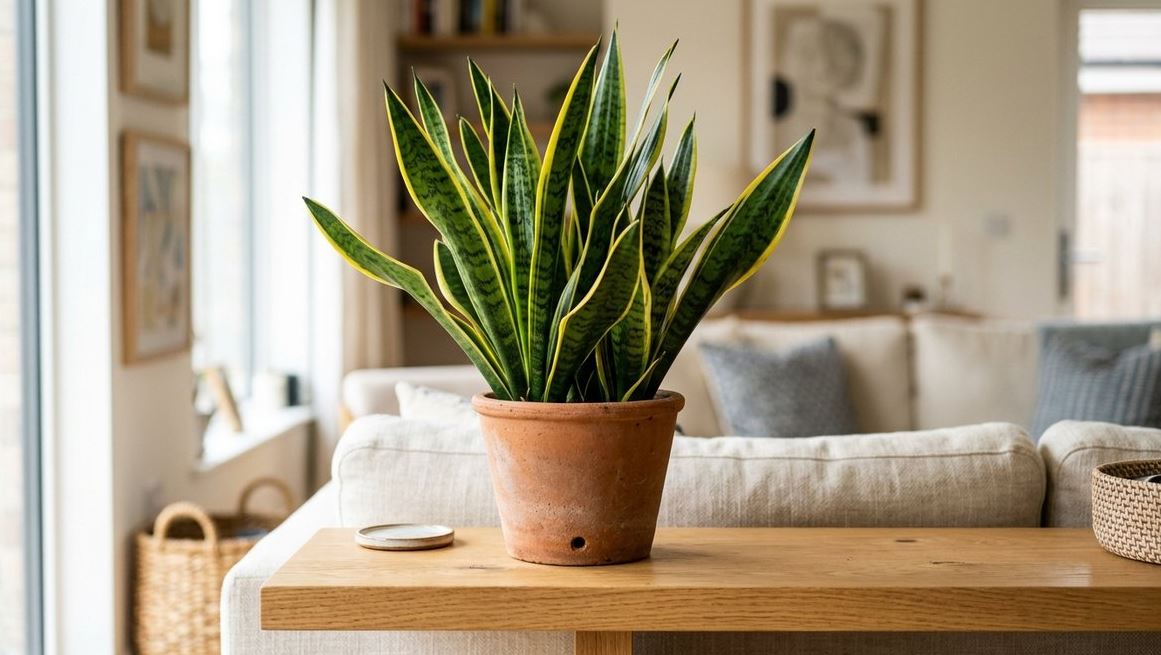
Some houseplants act like needy roommates. Humidity trays, misting schedules, perfect light angles; miss one detail and they sulk. The snake plant barely asks for your attention. It thrives in office corners, bedroom windowsills, and dim apartment hallways where fussier plants turn to compost. That resilience made it one of the most popular indoor plants worldwide.
Easygoing still means some effort. This West African succulent has preferences. Nail the basics and yours might outlast your lease. Ignore them and you’ll stare at mushy leaves or sudden brown spots, wondering what went wrong.
What Makes Snake Plants Worth the Hype
The snake plant benefits extend past those upright, architectural leaves. Back in 1989, NASA flagged Sansevieria trifasciata (reclassified as Dracaena trifasciata in 2017) as a houseplant that scrubs formaldehyde, xylene, toluene, and nitrogen oxides from indoor air. Whether that lab result translates to your living room is still argued. What’s not debated: the plant performs CAM photosynthesis. Most plants release oxygen during daylight. Snake plants flip the script, absorbing CO2 and pushing out oxygen after dark. That quirk alone makes them a bedroom favorite.
They sip water like camels. Thick, sword-shaped leaves store moisture the way other succulents do. A three-week vacation? Your snake plant won’t even notice. Most tropical houseplants would be crispy history.
The aesthetic range helps too. Tall varieties fill empty vertical space. Compact cultivars squeeze onto cluttered desks. Variegation runs from yellow margins to silver streaks, fitting nearly any interior.
Snake Plant Light Requirements and Placement
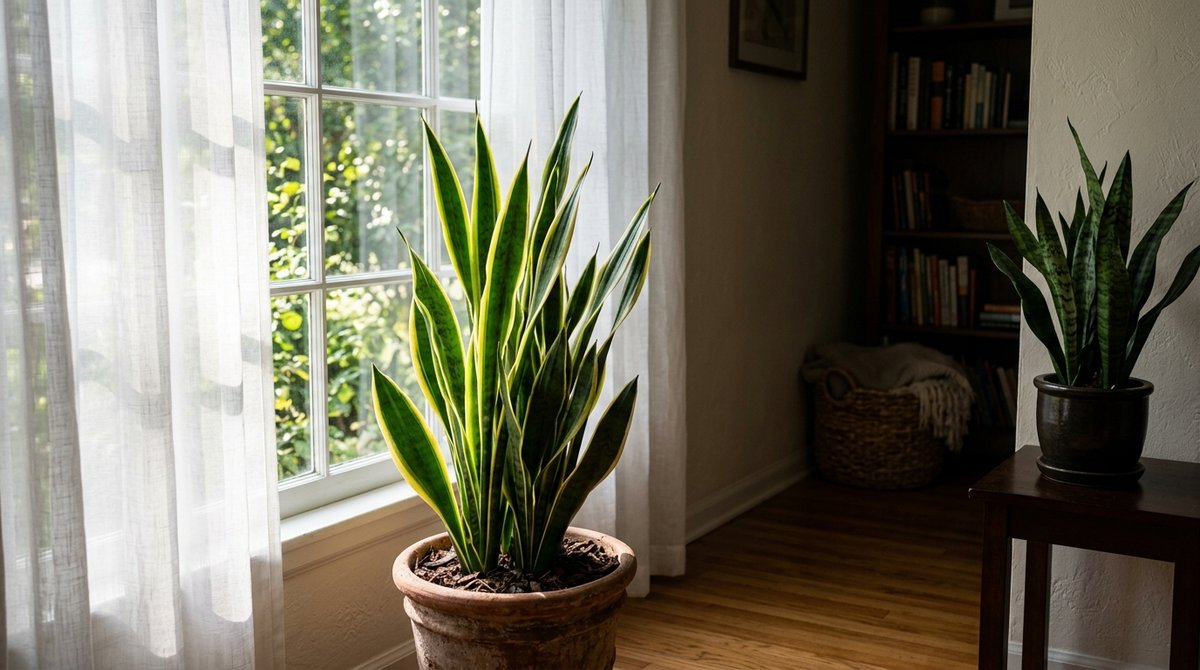
Here’s where snake plant care gets almost embarrassingly simple. These plants tolerate everything from bright, indirect light to dim corners far from windows. Direct southern exposure can scorch leaves, leaving bleached or brown patches. Deep shade drags growth to a crawl. Leaves fade. The plant limps along anyway.
Placement depends on what you’re after. Chasing vigorous growth? Maybe flowers? East- or north-facing windows with bright, filtered light deliver. That dark hallway where ferns go to die? Snake plants tolerate it. Growth just crawls.
Variegated types need more light than plain green ones. Less chlorophyll in those pale leaf sections means harder work for photosynthesis. Push a ‘Laurentii’ into deep shade and watch it surrender its stripes, going mostly green to stay alive.
How Often to Water Snake Plant
Overwatering kills more snake plants than every pest, disease, and neglect scenario combined. Those thick, fleshy roots evolved for dry spells. Soggy soil rots them fast. This is the single most important rule to internalize.
During active growth in spring and summer, watering every two to three weeks typically suffices for plants in standard indoor conditions. In fall and winter, when growth slows, extend that to monthly or even longer. The exact snake plant watering schedule depends on your home’s temperature, humidity, pot size, and soil composition.
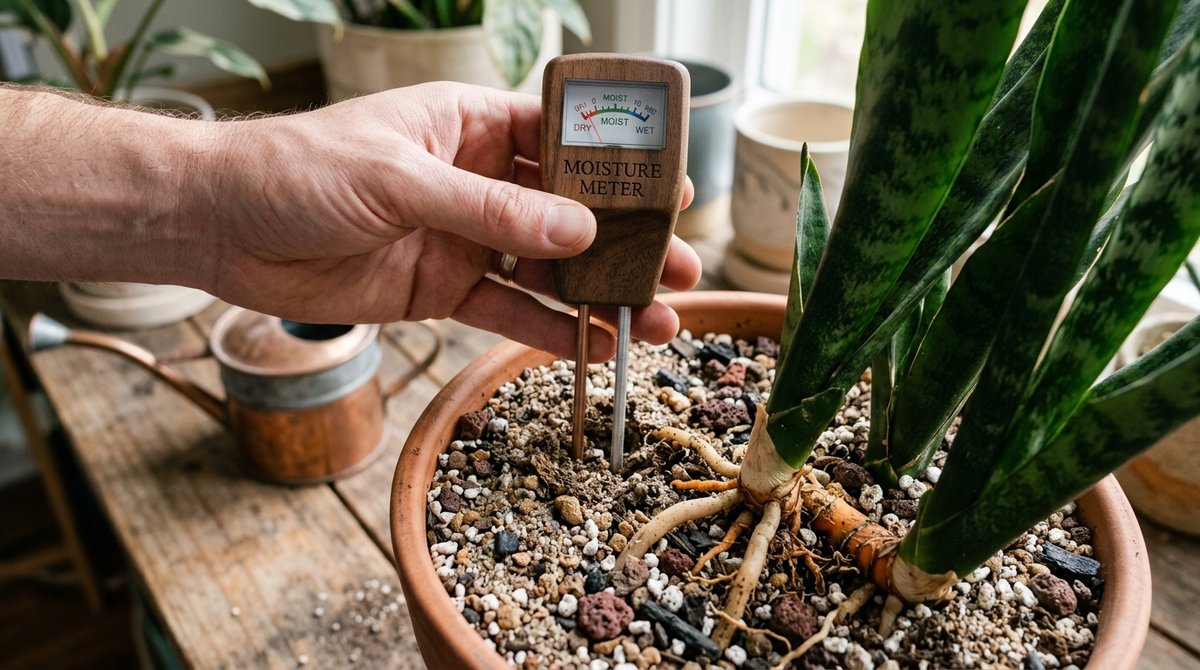
The only reliable method is checking the soil. Insert your finger several inches deep, or use a wooden skewer. If it comes out clean and dry, water thoroughly until liquid drains from the bottom holes. If any moisture clings to the skewer, wait. Never let the pot sit in standing water.
Signs of overwatering include:
- Soft, mushy leaves near the base that collapse when pressed
- A foul, rotten smell from the soil indicating root decay
- Yellowing leaves that detach easily
- Visible fungus gnats hovering around the pot surface
Underwatering causes leaves to wrinkle or curl inward, becoming thin and flexible rather than plump. Recovery from underwatering is usually straightforward; recovery from root rot often requires propagation from whatever healthy tissue remains.
Snake Plant Soil and Repotting Essentials
Standard potting mix retains too much moisture. Snake plant soil needs excellent drainage, which means amending heavily or starting with a cactus and succulent blend. A reliable homemade mix combines two parts potting soil, one part coarse sand or perlite, and one part orchid bark or pumice for aeration.
Container choice matters as much as the mix. Terracotta pots wick moisture away from roots, providing an extra buffer against overwatering. Plastic and ceramic containers work but require more careful watering. Whatever material you choose, drainage holes are non-negotiable.
Repotting is about timing and technique. These plants like being slightly root-bound. Every two to five years works, or when roots circle the pot or poke from drainage holes. Spring is best; recovery happens fast then.
When repotting, handle the thick rhizomes gently. They break easily, and damaged tissue invites rot. Position the plant at the same soil depth as before; burying it deeper can cause stem rot. Wait one week after repotting before watering to allow any root injuries to callus.
How to Propagate Snake Plant
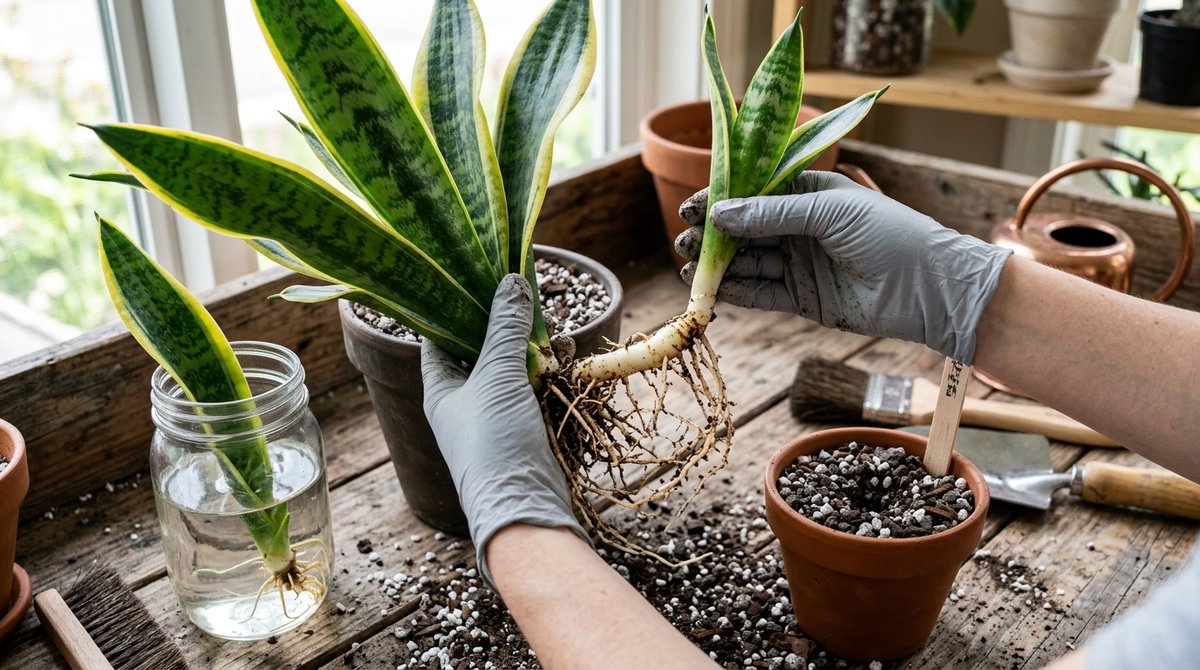
Propagating snake plant is almost as easy as keeping the parent alive. Three methods work reliably, each suited to different situations.
Division is fastest and preserves variegation. Remove the plant from its pot and identify natural clumps connected by underground rhizomes. Cut or pull these apart gently. Each section needs healthy roots and several leaves. Pot in fresh, dry soil. Wait a week to water.
Leaf cuttings suit solid green varieties only. Variegation disappears with this method. Cut a healthy leaf into 2-3 inch segments, keeping track of which end was closest to the soil. Plant segments bottom-down in moistened succulent mix. Roots develop in one to three months.
Snake plant propagation in water offers the satisfaction of visible progress. Cut a healthy leaf near the base and place the bottom inch in clean water, changing it weekly to prevent bacterial growth. Roots appear in four to eight weeks, though the transition to soil can shock water-rooted plants. Gradually add soil to the water over a week before full transplanting.
Patience is essential regardless of method. Snake plants are slow growers, and new plants may sit apparently dormant for weeks before suddenly pushing fresh growth.
Snake Plant Flower, Fertilizer, and Common Problems
A blooming snake plant flower is uncommon indoors but not impossible. Slender stalks emerge. Small, tubular, cream-colored blooms cluster along them, smelling sweet and slightly sticky. Flowering hits in spring or summer. Mature plants manage it, usually ones slightly stressed and root-bound. You can’t force it. Conditions simply align sometimes.
Fertilizer needs are minimal. A balanced, diluted liquid fertilizer applied once in spring and once in mid-summer provides sufficient nutrients. Over-fertilization causes salt buildup that burns leaf tips. Skip feeding entirely in fall and winter when metabolic activity drops.
For snake plant brown leaves fix scenarios, diagnose before treating:
| Symptom | Likely Cause | Solution |
|---|---|---|
| Brown, crispy leaf tips | Low humidity, fluoride/chlorine in tap water, or fertilizer salt buildup | Use filtered water, flush soil periodically, increase ambient humidity slightly |
| Soft, brown, mushy leaves | Root rot from overwatering | Remove affected tissue, propagate healthy portions, adjust watering schedule |
| Brown spots with yellow halos | Fungal infection (often from leaf wetness) | Improve air circulation, avoid wetting leaves, remove severely affected tissue |
| Sunken, reddish-brown lesions | Bacterial soft rot | Isolate plant, remove affected areas with sterile tools, may be irreversible |
Pest issues are relatively rare but not unheard of. Mealybugs and spider mites occasionally appear, particularly on stressed or overcrowded plants. Isopropyl alcohol on a cotton swab handles mealybugs effectively. Spider mites respond to increased humidity and occasional leaf wiping.
Safety Considerations and Pet Owners
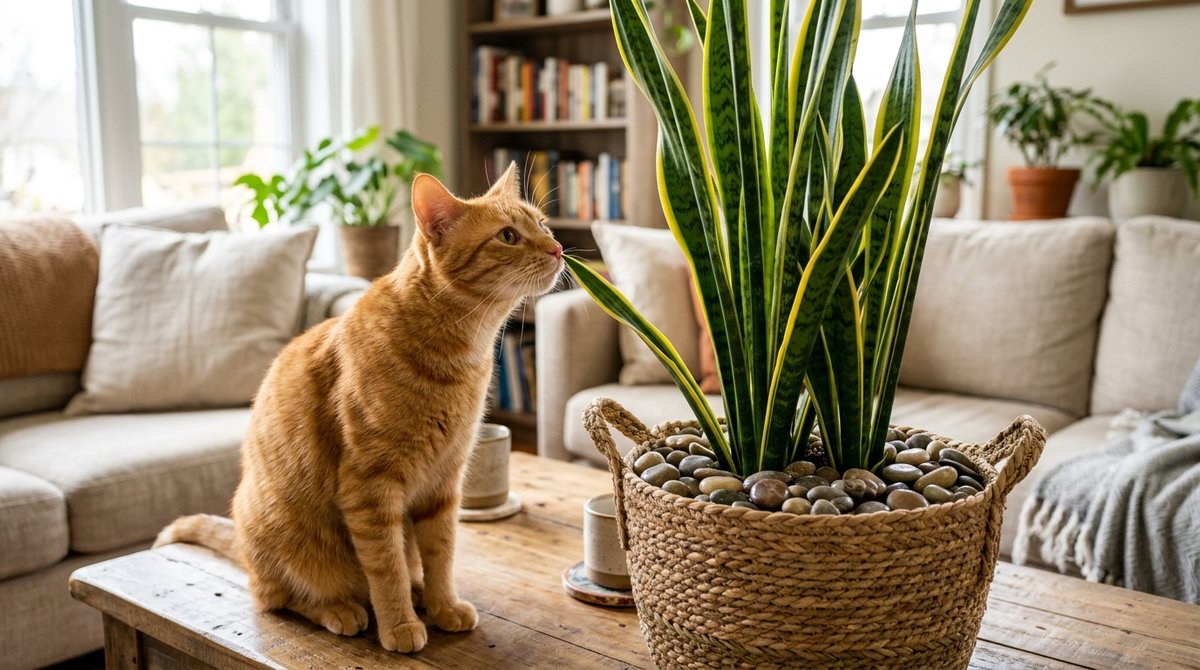
The question of whether snake plant toxic to cats and dogs is unfortunately yes. All parts contain saponins, compounds that cause gastrointestinal distress if ingested. Symptoms include vomiting, diarrhea, drooling, and reduced appetite. The toxicity is generally mild to moderate, rarely life-threatening, but definitely unpleasant for your pet and your carpet.
Strategic placement is the simplest prevention. Elevated shelves, hanging planters, or rooms your pets can’t access keep everyone safe. If you suspect ingestion, contact your veterinarian or the ASPCA Animal Poison Control Center. The plant’s bitter taste usually deters repeat sampling, but curious kittens and puppies may not learn that lesson immediately.
For households with plant-chewing pets, consider alternative greenery or secure placement as part of your indoor ecosystem planning.
Snake Plant Varieties to Know
The species has been cultivated extensively, yielding dozens of cultivars with distinct appearances. A few standouts dominate the market:
- Dracaena trifasciata ‘Laurentii’: The classic, with yellow margins on dark green leaves. Most widely sold and recognized.
- ‘Zeylanica’: Narrower leaves with silver-green horizontal striping, more subtle than variegated types.
- ‘Moonshine’: Unusual silvery-green foliage that darkens with age or lower light. Stunning in bright conditions.
- ‘Bird’s Nest’ (Hahnii): Compact, rosette-forming growth to about 6 inches tall. Ideal for desks and small spaces.
- ‘Cylindrica’ (now D. cylindrica): Round, finger-like leaves that can be braided or left natural. Different species, same easy care.
- ‘Bantel’s Sensation’: White vertical stripes on green, slower growing and somewhat harder to find.
Collecting different varieties has become its own small obsession for many indoor gardeners. The care requirements remain broadly similar across cultivars, though variegated forms need marginally more light to maintain their color patterns.
Connecting Your Indoor Garden to Bigger Systems
Individual plant care matters, but so does understanding how your choices fit into larger patterns. The houseplant industry has significant environmental footprints in propagation, shipping, and peat-based soil production. Keeping plants alive long-term, propagating your own, and choosing sustainable growing media reduces that impact.
For those interested in how technology is reshaping plant cultivation more broadly, vertical farming developments offer fascinating parallels. The same principles of controlled environment agriculture, resource efficiency, and adaptive growing techniques apply whether you’re managing a commercial facility or a windowsill collection.
Similarly, urban greening initiatives demonstrate how individual and collective plant stewardship improves air quality, mental health, and community resilience. Your snake plant is a small part of that larger picture.
Frequently Asked Questions
Basic Care and Troubleshooting
How often to water snake plant in winter versus summer?
Water roughly every 2-3 weeks in spring and summer when growth is active, extending to 4-6 weeks or longer in fall and winter. Always verify soil dryness several inches deep before adding water. Environmental factors like heating systems, humidity levels, and pot material significantly affect actual timing.
Why are my snake plant leaves falling over?
Drooping leaves usually indicate overwatering and incipient root rot. Check the roots immediately. Healthy roots are firm and white or orange; rotted roots are black, mushy, and foul-smelling. Remove affected tissue and repot in fresh, dry mix. Underwatering can also cause drooping, but the leaves will be wrinkled rather than mushy.
Can snake plants grow in bathrooms?
Yes, provided there’s sufficient light. The higher humidity benefits the plant, but low light from small or frosted windows may cause etiolation (stretching and weakening). A bathroom with a decent window often works well; a windowless powder room doesn’t.
Propagation, Safety, and Special Situations
How to propagate snake plant most reliably?
Division preserves variegation and produces mature plants fastest. For single leaves, soil propagation of cuttings is more reliable than water rooting, though watching roots develop in water is undeniably satisfying. Expect 1-3 months for root development and several more months for visible new growth.
Is snake plant toxic to cats if they just sniff it?
Simply smelling or rubbing against the plant poses no danger. Toxicity requires ingestion of plant material. The saponins cause irritation upon contact with mouth tissues, so most animals stop after an initial nibble. Monitor for vomiting or lethargy if you suspect eating occurred.
Will my snake plant flower indoors?
Possibly, but unpredictably. Mature plants that are slightly root-bound and receiving bright light have the best chance. The flower stalk emerges from the leaf base, reaching 1-3 feet tall with clusters of small, fragrant, cream-colored blooms. Flowering doesn’t harm the plant and may be followed by small orange berries.
What is the best fertilizer for snake plants?
A balanced, water-soluble houseplant fertilizer diluted to half strength, applied at most twice yearly in spring and mid-summer. Alternatively, a slow-release granular product applied once in spring. Excess fertilizer causes more problems than underfeeding; when in doubt, skip it.
Sources
- National Aeronautics and Space Administration (NASA), 1989, “Interior Landscape Plants for Indoor Air Pollution Abatement,” https://ntrs.nasa.gov/citations/19930073077
- American Society for the Prevention of Cruelty to Animals (ASPCA), 2024, “Snake Plant: Toxic and Non-Toxic Plants,” https://www.aspca.org/pet-care/animal-poison-control/toxic-and-non-toxic-plants/snake-plant
- University of Florida IFAS Extension, 2021, “Sansevieria Production Guide,” https://edis.ifas.ufl.edu/publication/EP060
- Missouri Botanical Garden, 2024, “Dracaena trifasciata,” https://www.missouribotanicalgarden.org/PlantFinder/PlantFinderDetails.aspx?taxonid=279558
- Royal Horticultural Society, 2024, “Sansevieria trifasciata,” https://www.rhs.org.uk/plants/16321/sansevieria-trifasciata/details
