




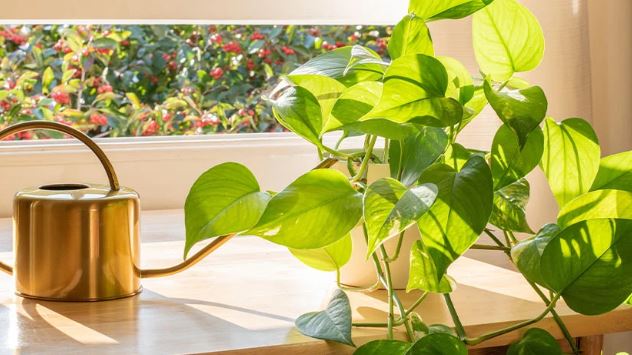
Pet and skin warning. Pothos (devil’s ivy) is toxic to dogs, cats, and horses. The ASPCA lists insoluble calcium oxalates as the toxic principle. Chewing can cause oral pain, swelling, drooling, vomiting, and trouble swallowing. If a pet chews this plant, call your veterinarian or ASPCA Poison Control at (888) 426-4435. A consultation fee may apply. The Royal Horticultural Society also advises wearing gloves, because the sap can irritate skin. This page is plant-care information, not veterinary advice.
The plant most people want when they look up pothos plant care is golden pothos. The Royal Horticultural Society (RHS) lists the widely grown form as Epipremnum pinnatum ‘Aureum’. Shops still sell it as Epipremnum aureum, devil’s ivy, or simply a pothos plant. It is an evergreen aroid with glossy, heart-shaped leaves and long stems that trail from a shelf or climb a moss pole.
How to care for pothos comes down to three checks: bright indirect light, compost that is allowed to approach dryness, and a pot that is never left standing in water. The RHS describes it as an easy houseplant for ordinary rooms. Unlike many tropical plants, it does not need high humidity. Golden pothos ‘Aureum’ also holds an RHS Award of Garden Merit for reliable performance.
If you are comparing easy aroids, the Monstera deliciosa care guide covers a related climber with a different light and support routine.
Pothos plant care at a glance
| Need | What to do | Source |
|---|---|---|
| Light | Bright, indirect light. East or west window, or a south window behind a sheer curtain. No direct summer sun. | RHS |
| Water | Water only when the compost is approaching dryness. Let the top 2 cm (about 1 inch) dry. Empty the saucer. | RHS |
| Temperature | 18–30°C (65–86°F). Keep it out of cold draughts and away from radiators. | RHS |
| Humidity | Average room humidity is enough. High humidity is not required. | RHS |
| Compost | Open, slightly acidic, moisture-retentive, and free-draining. See the mix below. | RHS |
| Feed | A general houseplant fertilizer once a month from April to October. | RHS |
| Pets | Toxic to dogs, cats, and horses. | ASPCA |
Pothos light requirements
Give the plant bright, indirect light. The RHS suggests a west-facing or east-facing window, or a south-facing window screened by a sheer curtain or blind. Direct sun, especially in summer, can scorch the leaves.
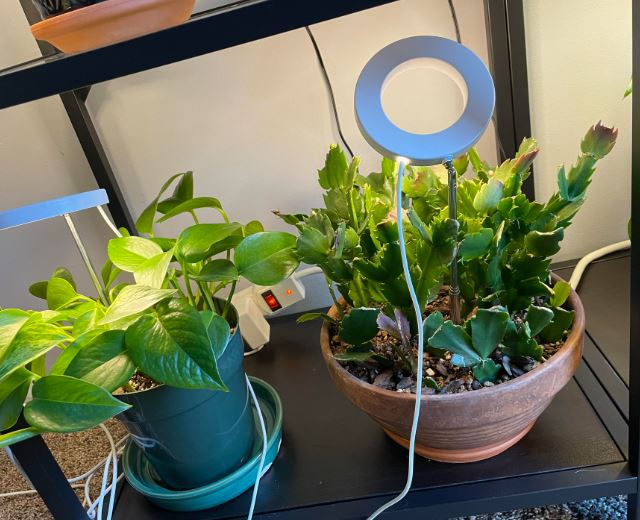
Some shade is tolerated, but deep shade is not. Too little light can fade variegation and slow growth. That matters for golden pothos and for cultivars sold with white or cream markings, such as Marble Queen. An all-green plant will cope with a dimmer corner better than a heavily variegated one, because the green tissue is what captures light. If a variegated plant turns mostly green and the stems stretch, move it closer to the window, still out of direct sun.
A pothos hanging plant on a high shelf still needs that light on the upper leaves. A dark hallway will keep it alive for a while and then produce long, thin stems with smaller leaves.
Pothos watering
Do not water on a fixed weekday. Water only once the compost is approaching dryness, and test it with a finger first. The RHS plant guide puts the dry layer at the top 2 cm (about 1 inch). Use room-temperature rainwater or filtered water when you can, especially in a hard-water area, so the compost stays slightly acidic.
Then water thoroughly and let the excess drain. Do not leave the pot sitting in water. Compost that stays wet rots the roots. In winter, when the room is cooler and growth slows, the same finger test will usually mean fewer waterings. A moisture meter for houseplants is optional. The finger test is the method the RHS describes.
If the plant is climbing a moss or coir pole, keep that pole damp so the aerial roots can grip it. That is separate from soaking the compost.
Pothos soil and repotting
Epipremnum wants an open mix that holds some moisture and still drains. The RHS says a peat-free houseplant compost is acceptable. A better home mix is three parts ericaceous (acidic) peat-free compost, one part grit, and one part medium orchid bark.
That recipe is close to other aroid mixes. The comparison in aroid mix versus regular potting mix explains why a dense, peat-heavy bag stays wet too long in a pot.
A new plant can stay in its nursery pot for several years. Repot in spring when roots are crowded or growing out of the drainage holes. Move up one pot size only. A much larger pot keeps the extra compost wet and raises the risk of root rot. After that, repot every two or three years into a pot one size larger.
Temperature, humidity, and cleaning
Keep the plant between 18 and 30°C (65–86°F). Cold draughts from a door or window, and direct heat from a radiator, are both worth avoiding. Average indoor humidity is enough. You do not need a humidifier or a pebble tray for basic golden pothos care.
Wipe the leaves now and then with a damp cloth. Dust blocks light, and the RHS notes that a clean leaf absorbs light more efficiently. Wear gloves when you handle the plant. The sap can irritate skin.
Feeding
To improve growth, the RHS says you can feed once a month during the growing season, from April to October, with a general houseplant fertilizer. Skip feeding when the plant is not growing. Unused fertilizer in a cool, dim winter room does not replace light or correct wet compost.
Golden pothos, Neon, Marble Queen, and satin pothos
Golden pothos is the green-and-yellow plant the RHS names as Epipremnum pinnatum ‘Aureum’. Stems can reach 2 m (about 6½ ft) or more indoors, trailing or climbing. Retail moss poles are often about 1 m (about 3⅓ ft). Tie in any stem that will not attach, and keep the pole damp.
Neon, Marble Queen, N’Joy, and similar plants sold as pothos are variegated epipremnums. Use the same pothos care routine, and give the paler cultivars the brighter end of indirect light so the markings hold.
Satin pothos is a different plant. It is usually Scindapsus pictus, not Epipremnum. The silver-flecked leaves are the clue. Do not assume every number on this page was written for satin pothos. Bright indirect light and a free-draining mix are still the right starting point, but treat it as its own species when you buy it.
Training and pruning
Grow it as a trailer from a hanging basket or a high shelf, or train it up a moss or coir pole, wires, or a trellis. Stems that get too long can be cut back to just above a leaf. New shoots then come from the leaf joints, which makes a leggy plant bushier. The pieces you remove are cuttings. Wear gloves.
Pothos propagation
Pothos propagation is simple because stems root from the leaf joints. The RHS gives two methods:
- Stem cuttings. Take a section of stem and trim just below a leaf joint. Stand it in a glass of water in a bright spot, out of direct sun. Pot it once roots appear.
- Layering. Pin a trailing stem onto free-draining compost. Roots should form at the leaf joint while the stem is still attached to the parent plant.
Wear gloves for both. A cutting with no leaf joint will not root.
Yellow leaves, scorch, and weak growth
Start with the compost. If a pothos plant has yellow leaves and the mix is still wet a week after watering, you are in the failure the RHS warns about: compost kept too wet, or a pot left standing in water, which rots roots. Stop watering, empty the saucer, and check that the pot has drainage holes. If the plant does not steady after the mix is allowed to dry properly, use the guide to when a houseplant problem is beyond DIY.
Other sourced problems look different:
- Scorched patches after a sunny spell usually mean direct sun. Move the plant back from the glass.
- Fading yellow or white markings, plus long bare stems, usually mean too little light. Move it to a brighter indirect spot.
- A few older leaves at the base of a long stem can be removed when you prune. That is not the same pattern as many leaves yellowing at once on wet compost.
Is a pothos plant toxic to cats and dogs?
Yes. The ASPCA lists devil’s ivy, Epipremnum aureum, as toxic to dogs, cats, and horses. The toxic principle is insoluble calcium oxalates. Clinical signs are oral irritation, pain and swelling of the mouth, tongue, and lips, excessive drooling, vomiting (not in horses), and difficulty swallowing.
Keep plants out of reach, and do not leave cuttings in an open glass of water on the floor. If a pet may have chewed a leaf, contact a veterinarian or ASPCA Poison Control at (888) 426-4435. For the first-aid sequence after any houseplant is eaten, see the veterinary-approved guide to a cat that eats a houseplant.
FAQ
How often should I water a pothos?
There is no universal schedule. Water when the compost is approaching dryness and the top 2 cm (about 1 inch) is dry. A plant in a bright, warm room will need water sooner than one in a cool, dim room.
How do I care for a golden pothos indoors?
Bright indirect light, 18–30°C (65–86°F), a free-draining slightly acidic mix, and a monthly feed from April to October. Let the top of the compost dry, and never leave the pot in a saucer of water.
Why is my golden pothos losing its yellow markings?
The RHS links loss of variegation to too little light. Move the plant to a brighter east, west, or curtained south window. Direct sun can scorch leaves, so do not put it against hot glass.
Can I propagate pothos in water?
Yes. Trim a stem just below a leaf joint and stand it in water in a bright place until roots appear, then pot it into the free-draining mix above.
Is golden pothos safe for cats?
No. The ASPCA lists it as toxic to cats, dogs, and horses because of insoluble calcium oxalates.
Sources
- Royal Horticultural Society, How to grow epipremnum. Light, temperature, watering, compost recipe, feeding from April to October, pruning, and propagation.
- Royal Horticultural Society, Epipremnum plant guide. Top 2 cm drying depth, stem length, and the toxicity warning.
- ASPCA, Devil’s ivy. Toxic to dogs, cats, and horses. Insoluble calcium oxalates and clinical signs.
- ASPCA, Golden pothos. Same species listing for dogs and cats.
