




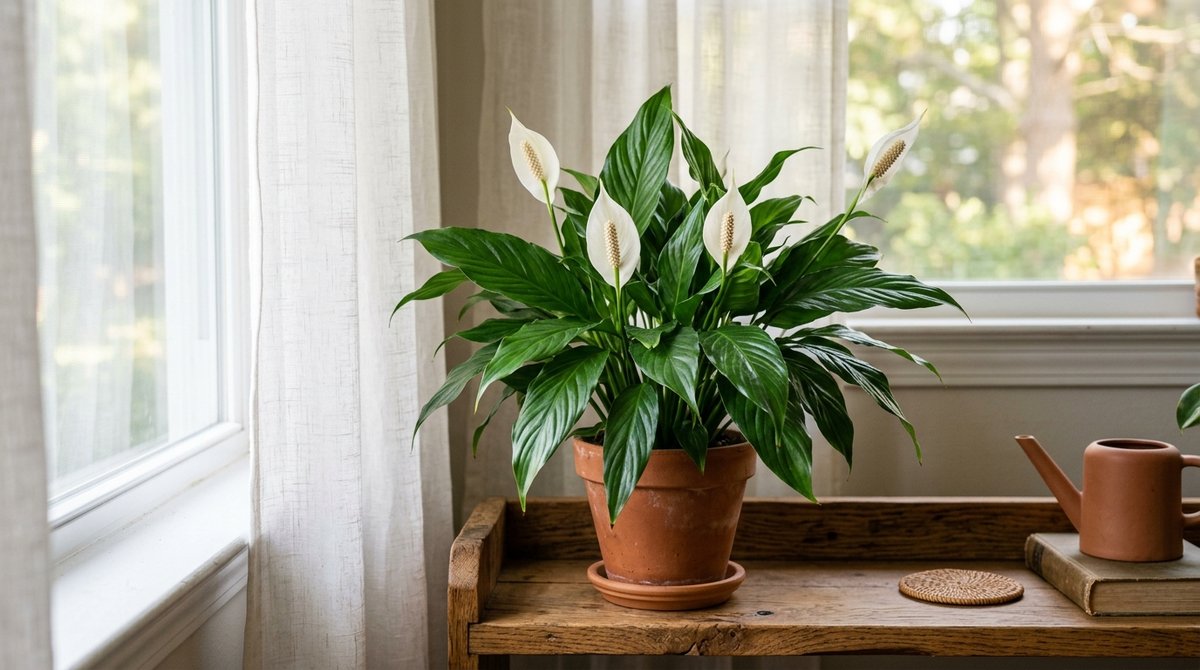
Spathiphyllum wallisii, commonly known as the peace lily, is one of the most reliable flowering houseplants for low-light interiors. Native to tropical forests in Colombia and Venezuela, it has adapted to survive on the forest floor beneath dense canopy, which explains its tolerance for shade and its preference for consistent moisture and humidity. Despite its forgiving nature, the plant gives clear signals when conditions drift outside its preferred range: drooping leaves for thirst, yellow foliage for watering errors, and brown tips for humidity or mineral stress.
Getting the fundamentals right means understanding what this plant actually needs rather than following generic houseplant rules. The following guide covers light, water, soil, temperature, feeding, and propagation with specific thresholds drawn from RHS and Kew guidance, plus essential safety information for pet owners.
Quick care summary
| Factor | Requirement |
|---|---|
| Light | Bright, indirect light; tolerates shade down to 75 lux (RHS) |
| Water | When top 2.5-5 cm of compost is dry; roughly weekly in summer, fortnightly in winter |
| Soil | Free-draining, peat-free potting mix with added perlite or bark |
| Temperature | 18-24°C (64-75°F); minimum 15°C (59°F) (Kew) |
| Humidity | 50-60% RH preferred; tolerates average household levels |
| Feeding | Balanced liquid fertiliser at half strength, every 6-8 weeks spring to autumn |
Light requirements
Peace lily light requirements are frequently misunderstood. The plant tolerates low light better than most flowering houseplants, but it will not flower in deep shade. The RHS lists Spathiphyllum as suitable for “shade to partial shade,” with a minimum acceptable light level around 75 lux for foliage survival, though 400-800 lux produces consistent blooms. Direct south-facing sun will scorch leaves within hours, causing bleached patches that do not recover.
For reliable flowering, position the plant 1-2 metres from an east- or north-facing window, or behind sheer curtains on a south-facing sill. If you notice fewer white spathes and more lanky, pale growth, light is the limiting factor. Rotate the pot 90 degrees weekly to maintain even growth, as the plant will lean toward its light source within 7-10 days.
Understanding what your indoor plants need in terms of light helps prevent the two most common errors: burning leaves with direct sun or starving blooms with too little energy.
Watering schedule and technique
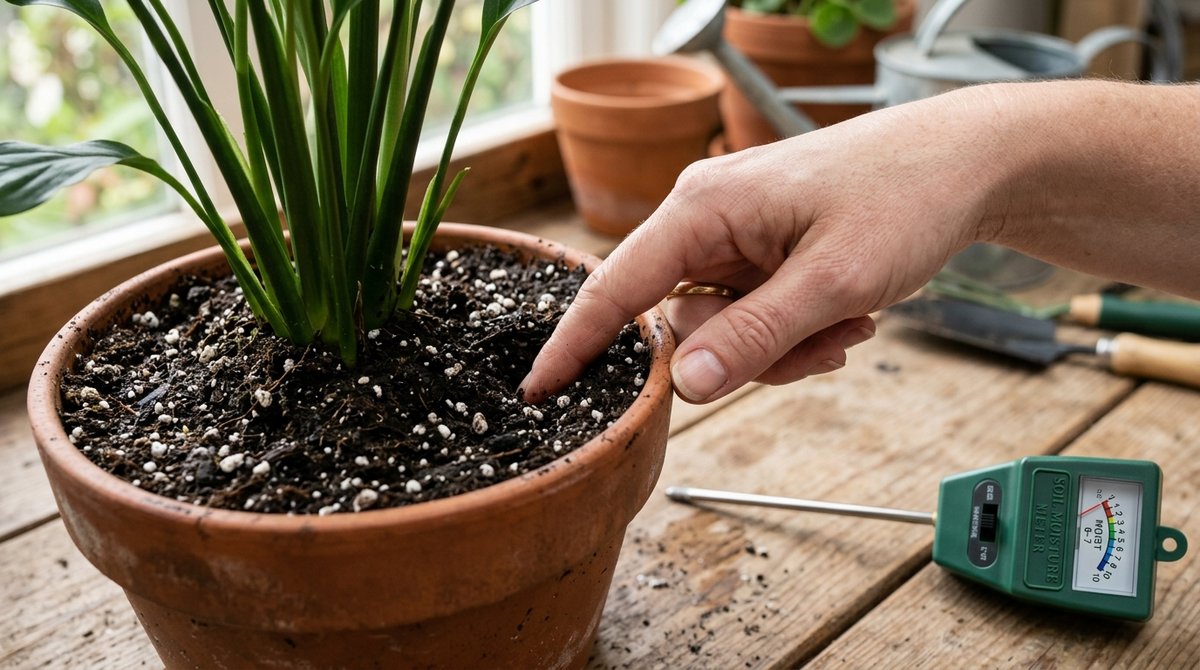
The question of how often to water a peace lily has no fixed calendar answer. Water when the top 2.5-5 cm of compost feels dry to the touch, not because it is Tuesday. In a centrally heated apartment, this typically means every 5-7 days in summer and every 10-14 days in winter. Use your finger or a soil moisture meter for apartment plants to remove guesswork; aim for a reading of 3-4 on a 10-point scale before rewatering.
When you do water, saturate the compost until water drains freely from the base, then discard the saucer contents after 30 minutes. Leaving the pot standing in water induces root rot within 2-3 weeks. The dramatic wilt that gives this plant its reputation for “telling you when it needs water” is actually a stress response; repeated wilting damages leaf cells and causes permanent browning at the margins. Water before the leaves droop, not in response to drooping.
Tap water is generally acceptable, but peace lily brown tips appear more frequently where water is hard (above 300 ppm calcium carbonate). If your kettle furs rapidly, use rainwater, filtered water, or allow tap water to stand overnight so dissolved gases dissipate. Fluoride at levels above 1 ppm can also accumulate in leaf tips over months.
Soil and repotting
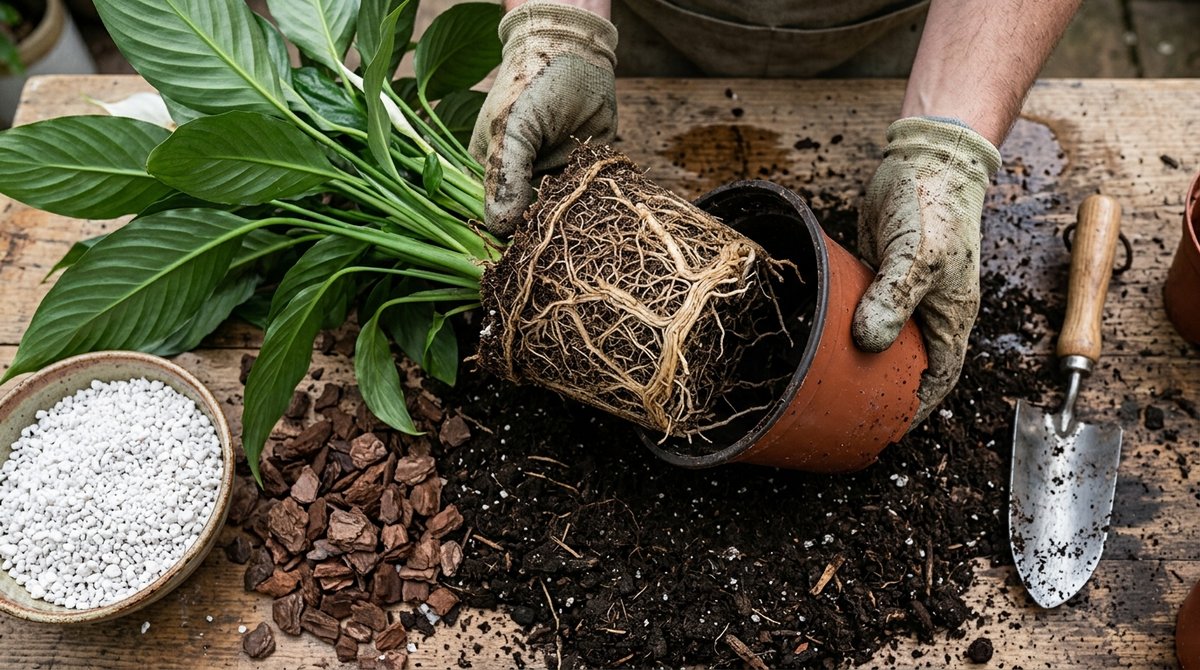
A suitable peace lily soil mix must balance moisture retention with drainage. The plant wants consistent root moisture but will not tolerate anaerobic conditions. Mix three parts peat-free multipurpose compost with one part perlite and one part fine orchid bark. This creates air pockets that prevent the root ball from becoming waterlogged while maintaining enough moisture between waterings.
Repot every 12-18 months in spring, or when roots visibly circle the pot base or emerge from drainage holes. Choose a container only 2.5-5 cm wider in diameter than the current one; excess soil volume stays wet too long and invites root rot. For a detailed walkthrough, see our step-by-step guide to repotting indoor plants.
After repotting, water thoroughly and place the plant in slightly lower light for 7-10 days to reduce transpiration stress while new root growth establishes. Do not fertilise for 6-8 weeks after repotting; fresh compost contains sufficient nutrients.
Humidity and temperature
Peace lily humidity needs reflect its tropical understory origin. While the plant survives at typical household humidity of 40-50% RH, it performs optimally at 50-60%. Below 40%, expect accelerated brown tipping on older leaves, particularly in winter when central heating dries air significantly.
Raise local humidity by grouping plants, placing the pot on a tray of damp pebbles (not submerged), or using a humidifier. Misting temporarily raises surface humidity by 10-15% for 30-60 minutes but does not meaningfully alter the surrounding air; it is cosmetic, not corrective. Maintaining humidity levels for apartment plants becomes especially relevant in heated winter environments where relative humidity can drop below 30%.
Temperature stability matters more than absolute warmth. Keep the plant between 18-24°C (64-75°F) during active growth, with a minimum of 15°C (59°F) overnight (Kew). Cold drafts from windows or doors, and hot air from radiators, both cause leaf damage within 48 hours. The plant will survive brief drops to 12°C (54°F) but may shed flowers and develop chlorotic foliage.
Feeding routine
Peace lily fertilizer routine should be conservative. These are not heavy feeders. Apply a balanced liquid fertiliser (20-20-20 NPK or similar) at half the manufacturer’s recommended strength, every 6-8 weeks from March to September. Overfeeding produces salt buildup in the compost, manifesting as brown, crispy leaf margins and a white crust on the soil surface.
If you notice these symptoms, flush the pot with three times its volume of water, allow to drain completely, and withhold fertiliser for 8-10 weeks. Never feed a stressed, wilting, or recently repotted plant; roots cannot process nutrients when compromised.
Common problems and fixes
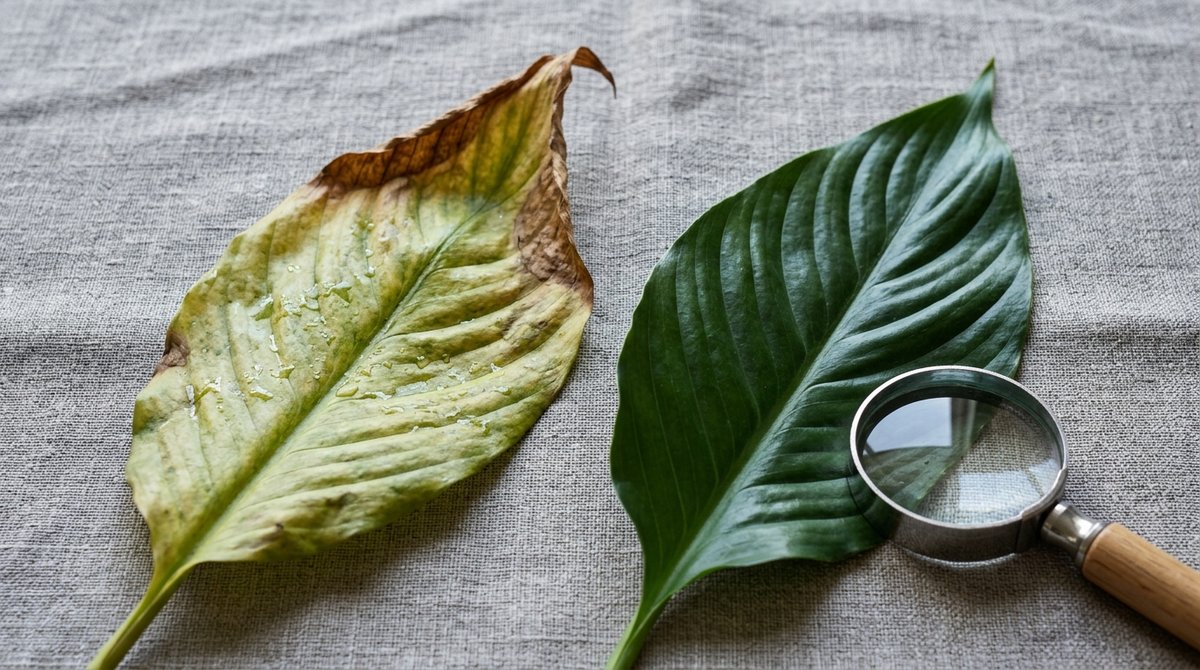
Peace lily yellow leaves
Peace lily yellow leaves indicate one of three conditions, with overwatering responsible in roughly 60% of cases. Check the root zone: if compost smells sour or roots appear brown and mushy, reduce watering frequency and consider repotting into fresh, drier mix. If older leaves yellow uniformly while new growth remains green, natural senescence is the cause; remove the leaf at the base. If yellowing is interveinal (between the veins) on new growth, this suggests iron or magnesium deficiency, usually from over-limey water or incorrect pH.
Peace lily brown tips
As noted, peace lily brown tips stem primarily from low humidity, mineral accumulation, or occasional underwatering. Trim dead tissue with sterile scissors, cutting to the natural leaf shape rather than straight across. Identify the cause before treating: check your water hardness, measure ambient humidity, and review watering consistency.
Drooping leaves
The peace lily drooping leaves fix is straightforward if caught early. Water thoroughly until drainage occurs; recovery typically begins within 2-4 hours and completes within 24. If the plant does not perk after watering, check for root rot (soft, dark roots) or cold damage. Chronic underwatering causes permanent wilting even after rehydration; the leaf cells collapse and cannot refill.
Propagation
Peace lily propagation tips centre on division, as these plants do not root reliably from leaf cuttings. In spring, remove the plant from its pot and gently tease apart the root mass into sections, each with at least two healthy leaves and a portion of the root system. Use a clean, sharp knife if roots are densely intertwined.
Plant divisions at the same depth in fresh compost, water well, and maintain humidity at 60% or higher for 2-3 weeks while new root growth establishes. Keep divisions out of direct sun and do not fertilise for 8 weeks. Success rate exceeds 80% when divisions have adequate root mass; small divisions with minimal roots often fail to establish.
For broader propagation techniques applicable to other houseplants, see our propagation tips for popular indoor plants.
Toxicity and pet safety
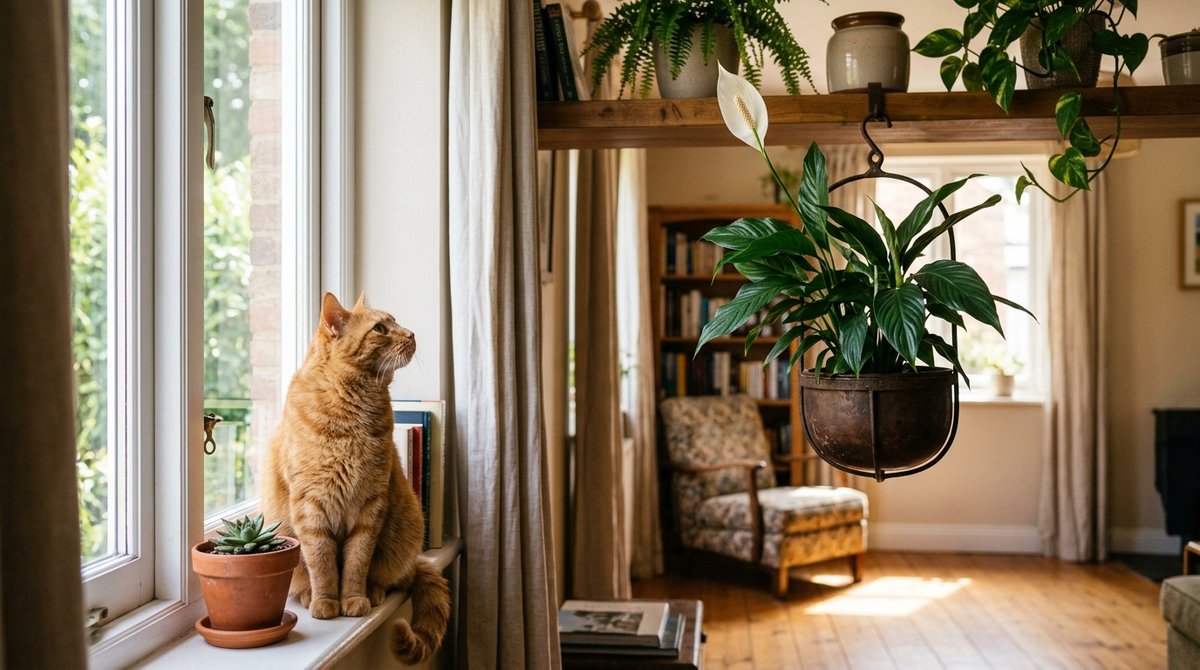
Important safety note: The peace lily is toxic to cats, dogs, and other mammals. All parts of the plant contain insoluble calcium oxalate crystals. When chewed or ingested, these crystals embed in oral and gastrointestinal tissues, causing immediate pain, drooling, pawing at the mouth, and difficulty swallowing. The ASPCA classifies Spathiphyllum species as toxic to both cats and dogs.
Symptoms typically appear within minutes to 2 hours of ingestion. Severity depends on the amount consumed and the size of the animal. While fatalities are rare due to the immediate pain deterrent (most animals stop eating after the first bite), veterinary attention is essential if any ingestion is suspected. Contact your veterinarian or the ASPCA Animal Poison Control Center at 888-426-4435 immediately. Do not induce vomiting unless instructed by a professional.
Keep plants on high shelves, in hanging planters, or behind physical barriers if you have cats that chew foliage. The peace lily meaning of tranquillity does not extend to pet safety; this plant requires proactive management in animal households.
Symbolism and cultural context
The peace lily meaning derives from its white spathe resembling a white flag of truce, combined with its association with purity and rebirth in several cultures. It is frequently gifted as a gesture of sympathy and appears in funeral arrangements across Europe and North America. The plant’s air-purifying reputation (NASA Clean Air Study, 1989) has been overstated in popular media; while it does remove certain volatile organic compounds from sealed chamber environments, the effect in ventilated rooms is negligible compared to standard air exchange.
Frequently asked questions
Watering and routine care
How often should I water my peace lily?
Water when the top 2.5-5 cm of compost is dry, typically every 5-7 days in summer and every 10-14 days in winter. Frequency varies with pot size, compost type, temperature, and humidity. Use a moisture meter or your finger rather than a calendar.
Can I use tap water for my peace lily?
Yes, though hard tap water (above 300 ppm calcium carbonate) contributes to brown leaf tips over time. If you notice tip burn, switch to rainwater, filtered water, or allow tap water to stand overnight before use.
Problems and safety
Why are my peace lily leaves turning yellow?
Yellow leaves most commonly indicate overwatering and root zone saturation. Other causes include natural ageing of older leaves, nutrient deficiency (interveinal yellowing on new growth), or cold damage. Check root health and watering frequency before applying fertiliser.
Is peace lily toxic to cats?
Yes. All plant parts contain insoluble calcium oxalate crystals that cause oral pain, drooling, and gastrointestinal distress. Contact a veterinarian or ASPCA Poison Control (888-426-4435) if ingestion occurs. Physical barriers or elevated placement are recommended in homes with cats.
Why does my peace lily have brown tips?
Brown tips result from low humidity (below 40% RH), mineral accumulation from hard water or over-fertilisation, or repeated underwatering. Trim damaged tissue with sterile scissors and address the underlying cause rather than treating symptoms alone.
How do I fix drooping peace lily leaves?
Water thoroughly until drainage occurs; recovery typically begins within 2-4 hours. If no recovery follows, inspect roots for rot or check for cold exposure. Prevent future drooping by watering before wilt occurs, not in response to it.
When should I repot my peace lily?
Repot every 12-18 months in spring, or when roots circle the pot or emerge from drainage holes. Use a container only slightly larger, with free-draining compost. Avoid repotting in autumn or winter when root growth is slow.
Sources
- Royal Horticultural Society. Spathiphyllum (Peace Lily) Plant Profile. https://www.rhs.org.uk/plants/17474/spathiphyllum/details
- Royal Botanic Gardens, Kew. Spathiphyllum wallisii. Plants of the World Online. https://powo.science.kew.org/taxon/urn:lsid:ipni.org:names:88934-1
- ASPCA. Spathiphyllum: Toxic and Non-Toxic Plant List for Cats and Dogs. https://www.aspca.org/pet-care/animal-poison-control/toxic-and-non-toxic-plants/spathiphyllum
- NASA. Interior Landscape Plants for Indoor Air Pollution Abatement (1989). https://ntrs.nasa.gov/citations/19930073077
