




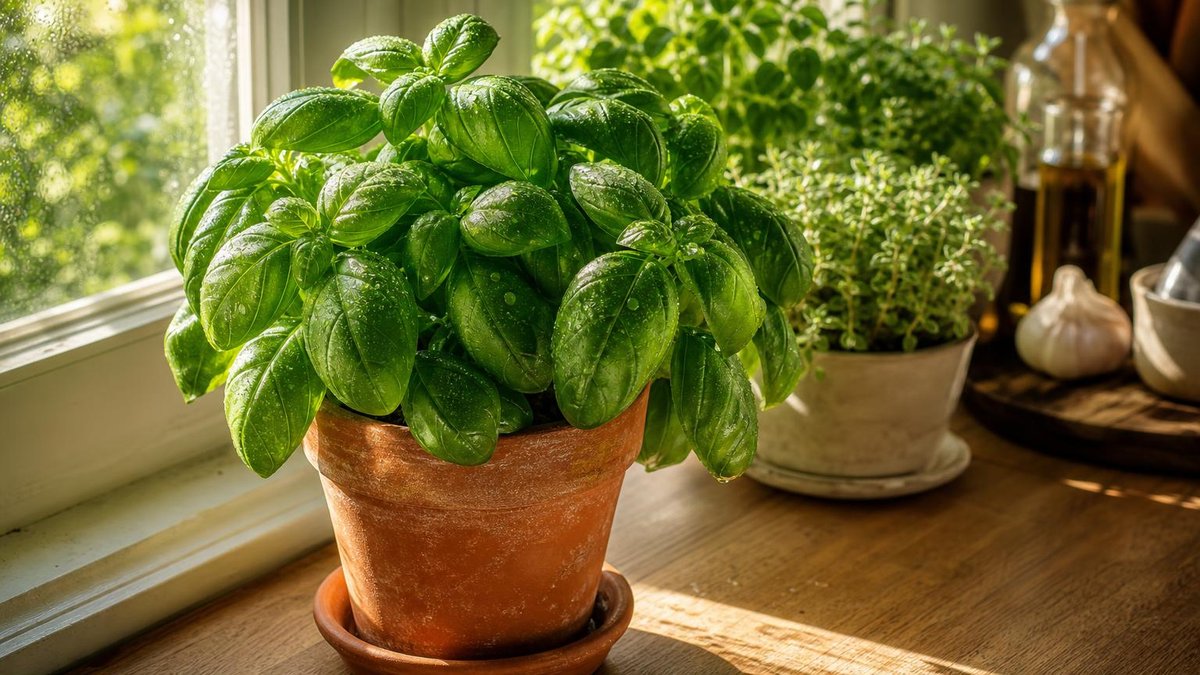
Fresh basil (Ocimum basilicum) is one of the most productive herbs you can keep on a kitchen counter. A single healthy plant yields enough leaves weekly for a family of four, provided you give it the light, warmth, and root conditions it actually needs. Growing basil indoors differs from outdoor cultivation in three measurable ways: light intensity must be higher, air circulation lower, and watering more precisely controlled. Get these right and you will harvest for months; get them wrong and you will watch seedlings damp off or mature plants turn woody and bitter.
Whether you are growing basil in pots on a windowsill or under full-spectrum LEDs in a basement, the underlying biology does not change. Basil is a tropical annual that evolved in India and Southeast Asia. It expects 16-24°C (61-75°F) days, humidity above 40%, and at least six hours of direct sun or equivalent. Replicate that and you replicate success.
Basil growing conditions: what the plant actually needs
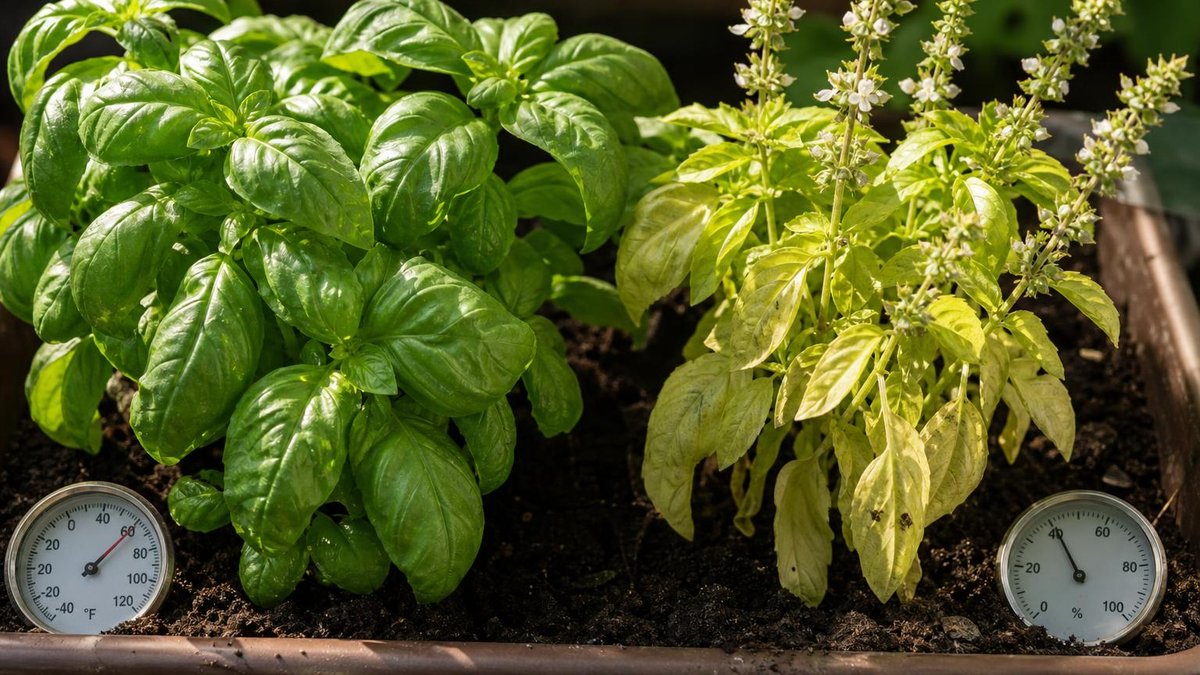
Basil is not a forgiving beginner plant, despite its popularity. It responds fast to stress with flavour loss, disease, or bolting. The RHS classifies it as requiring “full sun” and “moist but well-drained” conditions. Here is what that translates to indoors.
| Factor | Optimal range | Source |
|---|---|---|
| Day temperature | 18-24°C (64-75°F) | RHS, Ocimum basilicum profile |
| Night temperature minimum | 10°C (50°F) | Kew Plants of the World Online |
| Light duration | 6-8 hours direct sun, or 12-14 hours under LED | University of Minnesota Extension |
| Soil pH | 6.0-7.5 | RHS |
| Soil moisture trigger for watering | Top 2.5cm (1 inch) dry | Kew, cultivation guidance |
| Relative humidity | 40-60% | University of Maryland Extension |
Notice the light duration gap. Six hours of direct sun through glass equals roughly 12-14 hours under typical 20W LED grow lights because photosynthetic photon flux density is lower. If your only window faces north, you need supplemental lighting. Selecting the right plant lights means matching output to basil’s needs, not buying the most expensive fixture.
Growing basil from seed versus buying seedlings
Starting from seed gives you variety choice and cost control. A packet of 500 seeds costs less than a single supermarket seedling and lets you succession-sow every three weeks for continuous harvest. The trade-off is time and equipment.
For germination, sow basil seeds 6mm (1/4 inch) deep in moist seed compost at 21°C (70°F). The RHS states germination takes 5-10 days at this temperature; below 15°C (59°F), germination slows dramatically and rot risk rises. Use a heated propagator if your room runs cool. Cover trays with clear plastic to maintain humidity, but remove it the instant seedlings emerge to prevent damping off.
Thin or prick out seedlings when they have two true leaves. Space plants 15-20cm (6-8 inches) apart in final pots. Crowding reduces air flow and encourages grey mould (Botrytis cinerea), the most common indoor basil killer.
If you buy seedlings, inspect the stem base before purchase. Dark, water-soaked tissue at soil level means collar rot has already started. Reject any plant with yellow lower leaves combined with wet compost; this indicates root damage, not nitrogen deficiency.
Best soil for basil and container choice
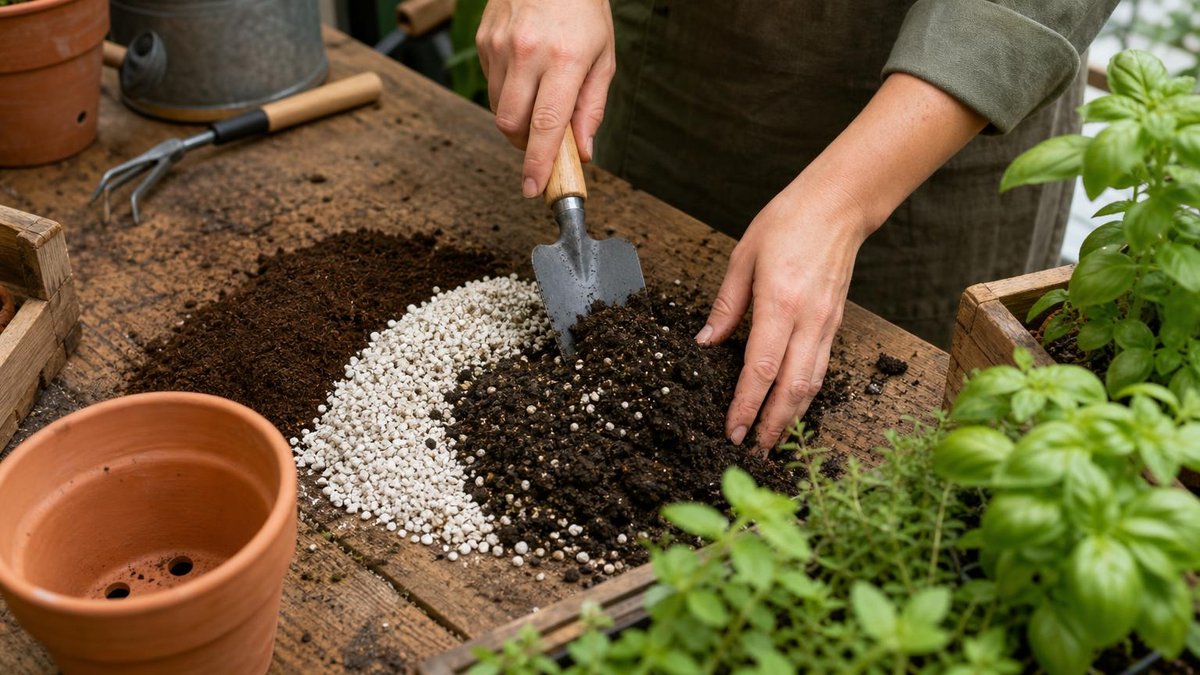
Basil roots need oxygen as much as water. Standard multi-purpose compost holds too much moisture for indoor conditions where evaporation is slow. The best soil for basil is a blend of:
- 60% peat-free multi-purpose compost
- 30% perlite or coarse grit for drainage
- 10% garden compost or worm castings for nutrient density
This approximates the loamy, well-drained soils of basil’s native range. Avoid water-retaining gels; they mask underwatering symptoms until root rot is advanced.
Container size matters for flavour, not just growth. A 15cm (6 inch) diameter pot holds enough root volume for a single plant to reach 30cm (12 inches) tall. Go smaller and the plant bolts early; go much larger and the soil stays wet too long. Terracotta breathes and helps prevent overwatering, but dries faster than plastic. Check terracotta pots daily in summer.
Drainage holes are non-negotiable. No decorative outer pot should hold standing water. If you use a saucer, empty it 30 minutes after watering.
Indoor basil watering schedule and technique
There is no fixed schedule. Water when the top 2.5cm (1 inch) of soil is dry, not because it is Tuesday, but because that is when the roots can take up oxygen between irrigations. In a warm, bright windowsill in summer, this may mean every two days. In a cool corner in winter, every ten days.
Water thoroughly until 10-15% drains from the bottom. This prevents salt buildup from fertilisers. Use room-temperature water; cold water shocks tropical roots and can cause leaf drop. If your tap water is very hard (above 300ppm calcium carbonate), use filtered water or collect rainwater.
Feed every two weeks with a balanced liquid fertiliser at half the manufacturer’s strength from April to September. The University of Maryland Extension recommends this reduced rate for container herbs to prevent lush, low-flavour growth. Stop feeding in winter unless you are growing under lights with temperatures above 18°C (64°F).
Basil lighting requirements: windowsills versus grow lights
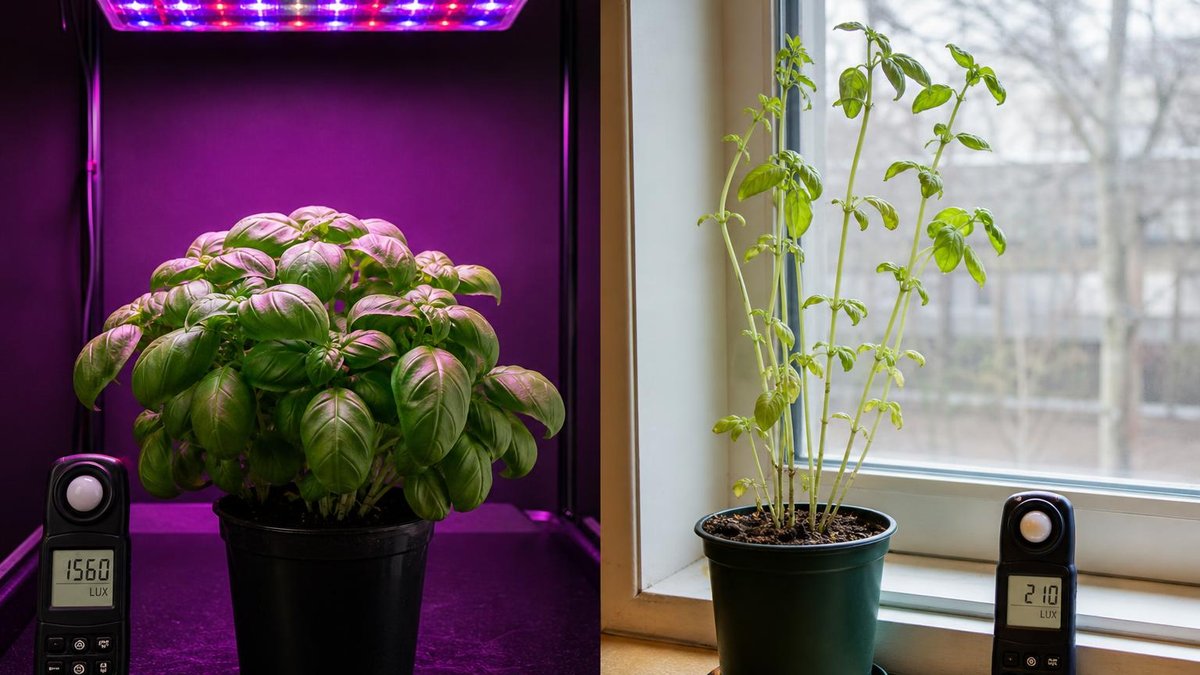
A south-facing window in the northern hemisphere provides 200-400 micromoles per square metre per second at the sill on a clear day. Basil needs roughly 300-400 µmol/m²/s for 12-14 hours to maintain compact growth and essential oil production. East or west windows give 100-200; north windows give 50-100. This is why growing a successful container garden indoors often requires artificial light, even in summer.
LED grow lights positioned 15-30cm (6-12 inches) above the canopy deliver adequate intensity without the heat stress of HID lamps. Look for full-spectrum fixtures with a colour temperature of 4000-6500K. Run them 14-16 hours daily on a timer. Basil does not need dark periods for flowering suppression, but a consistent cycle reduces stress.
Rotate pots quarter-turn weekly if using windowsills. Plants lean toward light; uneven exposure produces lopsided growth and weak stems.
Harvesting basil leaves to prolong production
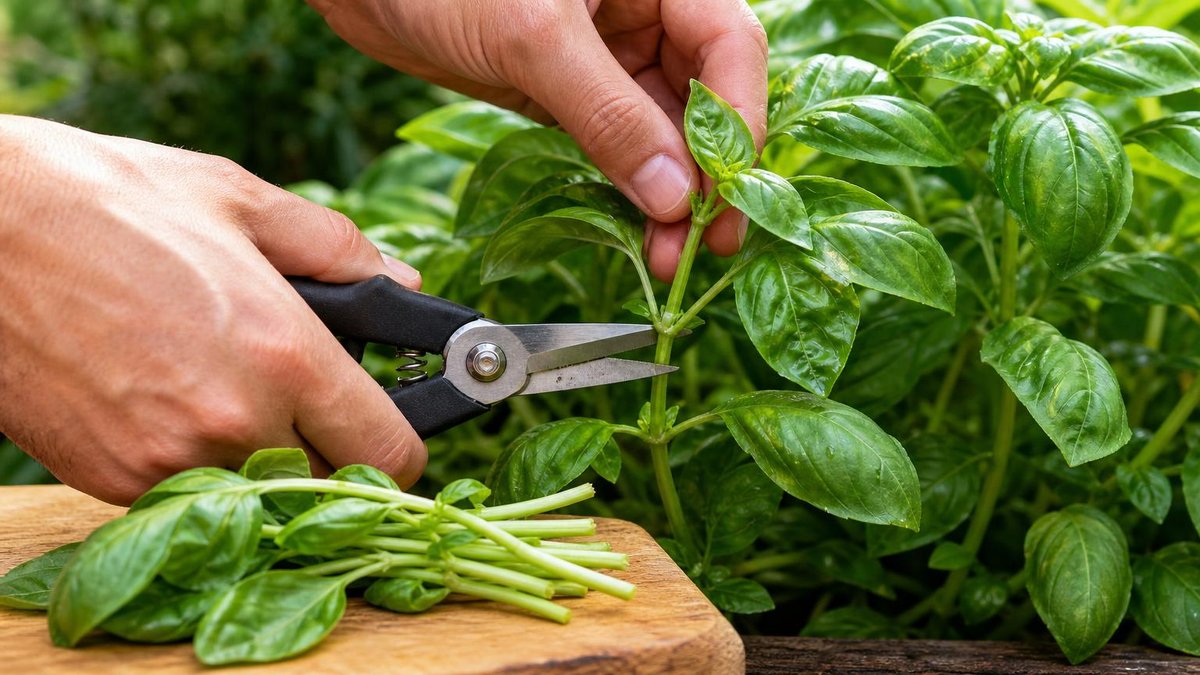
Harvesting technique determines plant lifespan. Never remove more than one-third of total leaf area at once; this stalls photosynthesis and triggers stress responses. Cut just above a leaf pair, not mid-stem. New growth emerges from the axillary buds at that node, creating bushier form.
Pinch flower buds the moment they appear. Flowering redirects energy from leaf production to seed set and triggers a bitter, camphor-like shift in essential oil profile. Genovese basil becomes noticeably harsher within days of inflorescence initiation. If you want to save seed, allow one plant to flower; keep others vegetative for kitchen use.
For maximum flavour, harvest in mid-morning after dew evaporation but before afternoon heat stress. Essential oil concentration peaks then, according to research on Ocimum species at Kew.
Basil pest control indoors
Indoor basil has fewer pest pressures than outdoor, but enclosed conditions let populations explode fast. The three common problems:
- Aphids (green peach aphid, Myzus persicae): clusters on new growth, sticky honeydew below. Control with physical removal under running water, then insecticidal soap applied to undersides of leaves. Repeat every five days for three cycles.
- Whitefly (Trialeurodes vaporariorum): tiny white insects disturbed from leaf undersides. Yellow sticky traps reduce adults; biological controls work in enclosed spaces but are impractical for single plants.
- Fungus gnats (Bradysia species): indicate overwatering. Larvae feed on roots in wet compost. Let soil dry to 5cm (2 inches) depth; top-dress with 1cm sand to break lifecycle.
Never use neem oil on plants you intend to harvest within seven days; residue persists and affects flavour. For severe infestations, discard the plant and sterilise the pot. It is faster and safer than protracted chemical treatment in a kitchen environment.
Growing Thai basil and other varieties indoors
Thai basil (Ocimum basilicum var. thyrsiflorum) differs from sweet Genovese in several measurable ways. It is more heat-tolerant, with optimal range 21-29°C (70-84°F), and more resistant to downy mildew. The leaves are sturdier, with anise-clove flavour from higher methyl chavicol content. It flowers more readily indoors; stay vigilant with bud removal.
Other varieties worth considering:
- ‘Spicy Globe’: compact to 20cm (8 inches), ideal for small pots
- ‘Red Rubin’: purple leaves, slightly lower light tolerance, needs brightest position
- Lemon basil (O. × citriodorum): distinct citrus notes, more sensitive to cold
All share the same core requirements but vary in cold sensitivity and flowering speed. Start with Genovese or Thai basil for reliability; experiment with others once you have consistent success.
Common problems and when to start again
Some indoor basil failures are recoverable; others mean beginning fresh. Grey mould on stems, blackened roots that smell sour, or severe aphid infestation on a flowering plant are all reasons to discard and sanitise. Do not compost diseased material; home composting rarely reaches temperatures that kill pathogens.
Leggy, pale growth with long internodes means insufficient light. Do not fertilise more; this worsens the problem. Move to brighter position or add supplemental lighting, then pinch back hard to lowest healthy node.
If lower leaves yellow uniformly while upper leaves stay green, check roots. If roots are white and firm, this is normal senescence; remove leaves and continue. If roots are brown and soft, this is root rot from overwatering. Let soil dry, reduce watering frequency, and consider repotting into drier mix. Severe cases require professional diagnosis or replacement.
Frequently asked questions
Starting and growing basil indoors
How long does basil take to grow from seed to harvest?
From sowing to first harvest is typically 6-8 weeks under optimal conditions. Germination takes 5-10 days at 21°C (70°F). Seedlings need 3-4 weeks to establish true leaves and root systems. Begin light harvesting at 15cm (6 inches) tall, but wait until plants have 6-8 leaf pairs for sustained production.
Can I grow basil indoors year-round?
Yes, with supplemental lighting and stable temperatures. Without grow lights, expect weak winter growth even on south-facing windowsills. The combination of short days and low sun angle drops light below productive thresholds for 2-3 months in northern latitudes. Growing basil indoors through winter requires 12-14 hours of artificial light daily.
Why is my indoor basil turning yellow?
Yellowing has three common causes, in order of frequency: overwatering (roots suffocated, unable to take up nutrients), nitrogen deficiency (pale older leaves first, in underfed plants), and cold damage (sudden temperature drop below 10°C / 50°F, often from window proximity in winter). Check soil moisture first; it is the culprit in roughly 60% of cases.
Care and harvesting
How often should I water basil in pots?
Water when the top 2.5cm (1 inch) of soil is dry. In practice, this ranges from every 2-3 days in summer to every 7-10 days in winter, depending on pot size, compost mix, light intensity, and indoor temperature. There is no universal schedule; the soil moisture test is the only reliable indicator.
Can I grow basil from supermarket cuttings?
Sometimes, but success is inconsistent. Cut 10cm (4 inch) tips from non-flowering stems, remove lower leaves, and place in water. Roots appear in 7-14 days at 20°C (68°F). However, supermarket basil is often multiple seedlings crowded in one pot, already stressed and flowering. For reliable results, buy seed or healthy nursery seedlings.
What is the best way to store harvested basil?
Short-term: stems in water at room temperature, like cut flowers. Refrigeration damages cell membranes and causes blackening within 24-48 hours. Long-term: pesto frozen in ice cube trays, or leaves blanched 2 seconds then frozen flat. Drying is possible but loses the volatile oils that define fresh basil flavour.
Is basil safe for pets?
According to the ASPCA, Ocimum basilicum is non-toxic to dogs, cats, and horses. Large ingestions may cause mild gastrointestinal upset due to fibre and essential oil content. For any suspected plant ingestion with symptoms, contact ASPCA Animal Poison Control at 888-426-4435 or your veterinarian.
Sources
- Royal Horticultural Society. Ocimum basilicum (Basil). https://www.rhs.org.uk/plants/1206/ocimum-basilicum/details
- Kew Royal Botanic Gardens. Plants of the World Online: Ocimum basilicum. https://powo.science.kew.org/taxon/urn:lsid:ipni.org:names:452650-1
- University of Minnesota Extension. Growing Basil in Home Gardens. https://extension.umn.edu/vegetables/growing-basil
- University of Maryland Extension. Basil Production Guidelines for the Herb Gardener. https://extension.umd.edu/resource/basil-production-guidelines-herb-gardener/
- ASPCA. Toxic and Non-Toxic Plant List: Basil. https://www.aspca.org/pet-care/animal-poison-control/toxic-and-non-toxic-plants/basil
